At Prada in September, every look in the spring/summer 2027 show included a skirt. By the time Paris closed on October 6, the rest of the season had followed: skirts instead of wide trousers, satin worn in daylight, sheer layers that barely seemed to touch the body, and color worn whole from collar to hem.
Spring 2027 felt like a season with a clear point of view. After several years of volume and spectacle, designers in New York, London, Milan, and Paris settled on cleaner shapes, lighter fabrics, and clothes made to be worn. Most of those ideas had already been chosen in fabric months earlier, and the garments that will carry them into stores next spring are on factory floors now.
For the autumn season running alongside it, see our pieces on the fall/winter 2027 color palette and autumn 2027 textures, fabrics, and silhouettes.

The Trends That Defined the Season
The skirt season
Miuccia Prada once compared a skirt to a T-shirt: a basic that can carry any idea. Her SS27 collection with Raf Simons put that into practice, and the season agreed. Nearly three in every ten runway looks included a skirt, up from roughly one in five a year earlier, according to runway analytics firm T-Fashion. Straight and pencil shapes led in Milan. In Paris, Dior, Chanel, and Aje sent long skirts that floated in light layers, while Saint Laurent paired gold pencil skirts with trench coats. London added high-low hems at Toga, Erdem, and McQueen, and the dropped-waist dress returned with little warning.
A narrower line
As the skirt rose, the wide trouser stepped back. Loose, relaxed trousers, a staple of the last several seasons, appeared in only about one look in thirty. The menswear shows in June set the direction: Prada showed skinny jeans and cropped trucker jackets, and Dior, Lemaire, and Auralee cut closer to the body. In Milan's womenswear, oversized blazers were scarce.
Satin by day
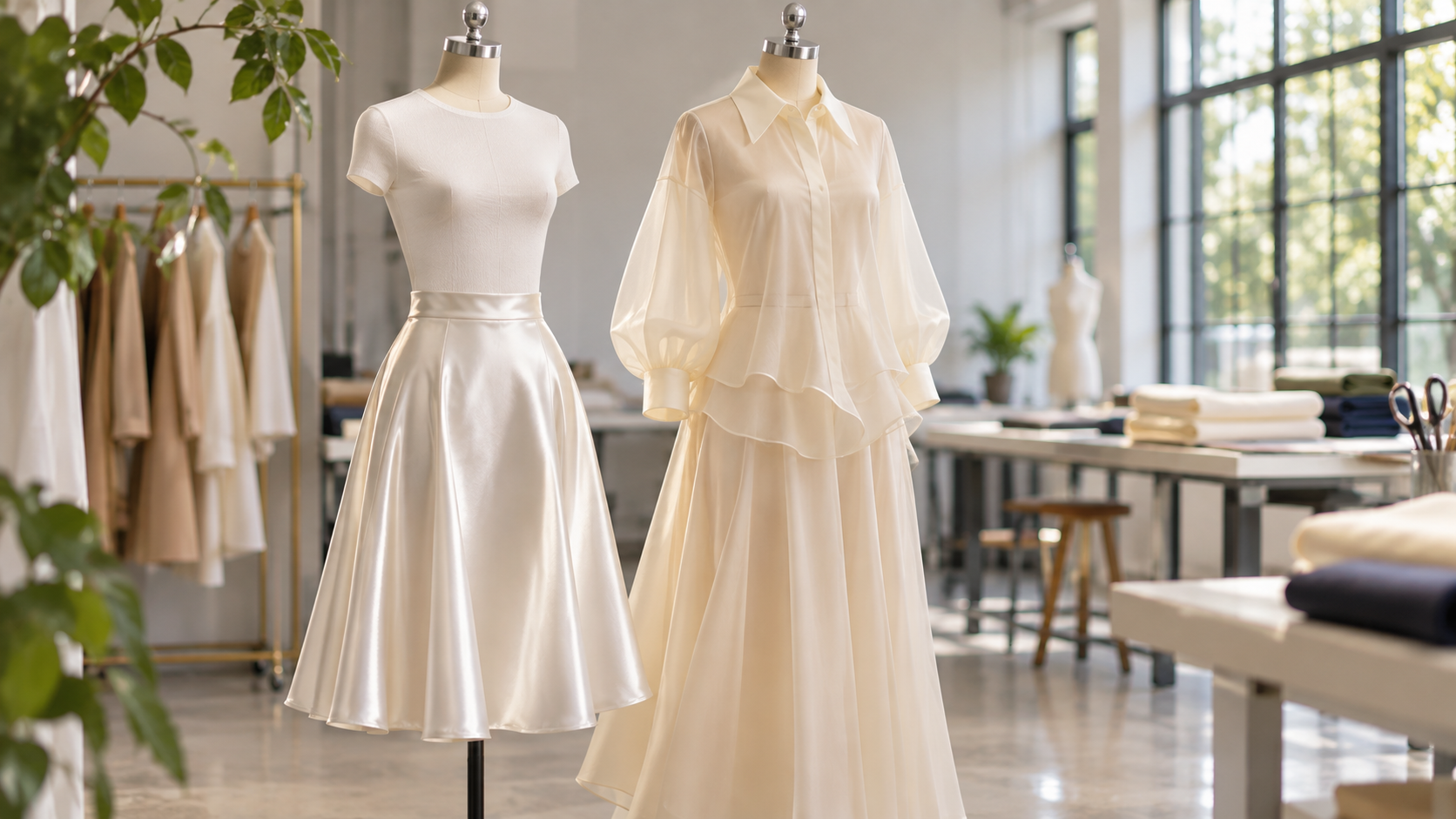
Satin appeared in about one look in five, more than any fabric except twill. New York showed liquid satin early in the season. In Paris, buyers singled out duchesse satin and high-shine finishes, and Saint Laurent, Dior, and Balmain carried the shine into gold and silver. Worn with a cotton shirt or a simple knit, satin moved from evening into the working week.
The lightness of being
Alongside the shine came fabrics that seemed to weigh nothing. Jonathan Anderson's Dior used airy, petal-like layers and deliberately imperfect shapes. Chanel worked sheer silks into the house codes, and L'Agence showed a trench coat light enough to drift. In menswear, Dries Van Noten and Prada showed whisper-thin, see-through shirts and trousers.
Color worn whole
Where color appeared, it often covered the whole look. Céline, Akris, and Stella McCartney showed head-to-toe single shades in Paris. Chanel, Balenciaga, and Celine paired canary yellow, true red, and cobalt in strong blocks. Underneath it all sat a crisp neutral base. White appeared in more than a quarter of all looks, up from the season before, and black remained the most worn color of the season.
Wardrobe over spectacle
The season's mood leaned toward clothes that work together. In menswear, the shows shifted from single hype pieces toward complete wardrobes. In womenswear, cleaner, more minimal looks gained ground on avant-garde styling.
"People can be individual with common garments if you really think how to wear them and how to combine them." Raf Simons, Prada
The Spring 2027 Palette
The trend forecaster WGSN and its color partner Coloro set the season's direction well before the shows, naming Luminous Blue the 2027 Color of the Year and four key colors for spring/summer 2027. The runways carried most of them through, alongside a few shades of their own.
Luminous Blue
WGSN's 2027 Color of the Year, mysterious and a little eccentric. On the runway it arrived as cobalt in New York and Paris, and as turquoise and aqua in Copenhagen.
Energy Orange
A high-vibrancy orange tied to resilience and adaptability. London leaned into it, and lighter ambers and yellow-oranges are expected to follow.
Meadowland Green
A calm mid-green linked to rest and a slower pace. Olive did similar work on the runway, standing in for beige at Loewe, Isabel Marant, Valentino, and Balenciaga.
Clay
A warm, earthy pink-toned neutral. It ran through the menswear shows with terracotta and sand, while Milan favored softer, powdery pinks.
Two colors came from the runway itself. Purple ran through Paris, from lilac bags at Chanel to royal purple at Miu Miu, and violet carried through Milan from the autumn 2026 collections. Gold moved from accessory to full look at Saint Laurent.
Pattern, Texture, and Denim
Florals, stripes, and checks all appeared more often than the season before. Burberry built its collection around bright florals and prints made with textile designer Celia Birtwell. Prada placed crisp botanical prints on skirts and light jackets. Texture showed up as fringe: tasselled evening dresses at Roksanda, fringed skirts and scarves at Ahluwalia, and fringe detail across Copenhagen, where it was one of the season's fastest-rising details.
Denim was styled as a set. A denim jacket or shirt worn with matching jeans appeared across all four cities. Zimmermann made denim dressy, and Miu Miu showed hand-laced jeans made with Wrangler. The fit of the moment is a relaxed straight leg, taking over from the curved barrel jean.
Where These Ideas Started
Little of this was new by September. In February 2026, close to 1,000 mills and suppliers from 36 countries gathered at Première Vision Paris to present fabric for spring/summer 2027. The show framed the season around a single idea, which it called Open: a turn from quiet luxury toward joy, color, and playful versions of familiar classics.
The fabrics on its tables read like a preview of the runway. Duchesse satins, mikados, and weighted silks for shape. Organzas, chiffons, and double gauzes for lightness. Firm, yarn-dyed linens for tailoring. Thin stripes with small embroidered florals for shirting, gingham reworked in sheer and textured qualities, and light denim with expressive surface treatments. Data from the analytics firm Heuritech, presented at the show, already had stripes, gingham, fine lace, and light denim gaining momentum.
By the time a look walks the runway, the fabric behind it has usually been woven, sampled, and ordered. The same calendar shaped the coats taking shape for winter 2027, which trace back to fabric decisions made in September 2026.
From Runway to Range
Each of the season's ideas carries a production decision behind it. These are the ones designers settle earliest when a spring range moves from sketch to sample.
Skirts
Waistbands, linings, and hems carry much of a skirt's finish, and fit depends on waist and hip grading. Fluid and bias-cut styles hang before hemming.
Satin and sheers
Satin rewards fine needles and careful pressing. Sheer fabrics call for French seams and narrow rolled hems. Both are set in the tech pack before sampling begins.
Color worn whole
A head-to-toe look asks every fabric and trim to match one approved shade, and each white needs its own standard. Lab dips settle both early.
Denim sets
Jacket and jeans are cut from the same fabric lots and washed to one recipe, so the set matches on the shelf.
Shade approvals and fit sit at the center of sample development, and the details that carry them into bulk start with a production-ready tech pack. For the categories leading the season, see our guides to women's apparel, dresses and blouses, knitwear, and denim and casual bottoms. Much commercial satin is polyester, for reasons covered in why so much of what we wear is now polyester.
Spring 2027 Is Already in Production
Runway coverage stops at the show. What follows is quieter: mills confirming yardage, factories reserving lines, and sample rooms approving the first bulk pieces. Collections delivering between January and March 2027 are moving through production now, and much of that work runs into Tet, the Lunar New Year, which falls on February 6, 2027. Factories in Vietnam slow in late January, Chinese fabric mills close at the same time, and full capacity typically returns in early March.
Brands developing new styles from these shows for later spring and summer drops can use that window for sampling and plan bulk production for after the holiday. Our guides to planning production around Tet 2027 and seasonal production planning set out both paths.
Tet 2027 Production Planner
The 2027 holiday dates, fabric cut-offs, the last ex-factory window, the Chinese mill closure, and the post-holiday restart on one timeline. Download the Tet 2027 Production Planner.

The Next Season Is Already Taking Shape
The cycle that produced spring 2027 is already running for the season after it. Mills are developing spring/summer 2028 fabrics now, and Première Vision Paris will present them early in 2027. The skirts, satins, and colors that walk the runway in September 2027 will have been chosen months before anyone sees them, in the same halls and the same sample rooms.
For designers, that is the useful part of reading a runway season. The shows confirm what was decided. The decisions for the next season are being made now.
Vietnam apparel manufacturing
Planning a spring range for production?
Pham Fashion House coordinates apparel production in Vietnam for brands, from fabric and sampling through bulk and export, with programs typically starting at 3,000 units per style. If you are mapping a 2027 or 2028 collection, we are happy to talk through the calendar.
Start a Conversation