Production-Ready Tech Packs: What Factories Actually Need Before Pricing and Sampling
A tech pack is the single most important document in apparel manufacturing. It is the specification that tells a factory what to build, how to build it, and what standard to measure the finished product against. Without a complete, production-ready tech pack, a factory cannot quote accurately, cannot develop a reliable sample, and cannot produce consistently at scale.
This is not a guide to creating your first tech pack. This is a guide to understanding what production partners and factories actually need from your documentation before they can move forward, and what happens when the specification is incomplete, ambiguous, or missing critical detail. For buyers approaching Vietnam production with serious volume, the tech pack is the starting point for every conversation about pricing, sampling, and timeline.
Why this matters before any other conversation
At Pham Fashion House, a finalized tech pack is a hard gate before pricing or sampling begins. Reference photos, sketches, and verbal descriptions are not substitutes. Accurate quoting depends on knowing the garment's construction, materials, measurements, and finishing in enough detail for the factory to plan labor, source materials, and estimate production time. Without that, any price is a guess.
What a Production-Ready Tech Pack Actually Contains
A tech pack that is ready for factory review is more than a design document. It is a manufacturing specification. The difference matters because a design-stage tech pack communicates the designer's intent, while a production-ready tech pack communicates what the factory needs to execute. The two overlap, but they are not the same thing.
Technical drawings
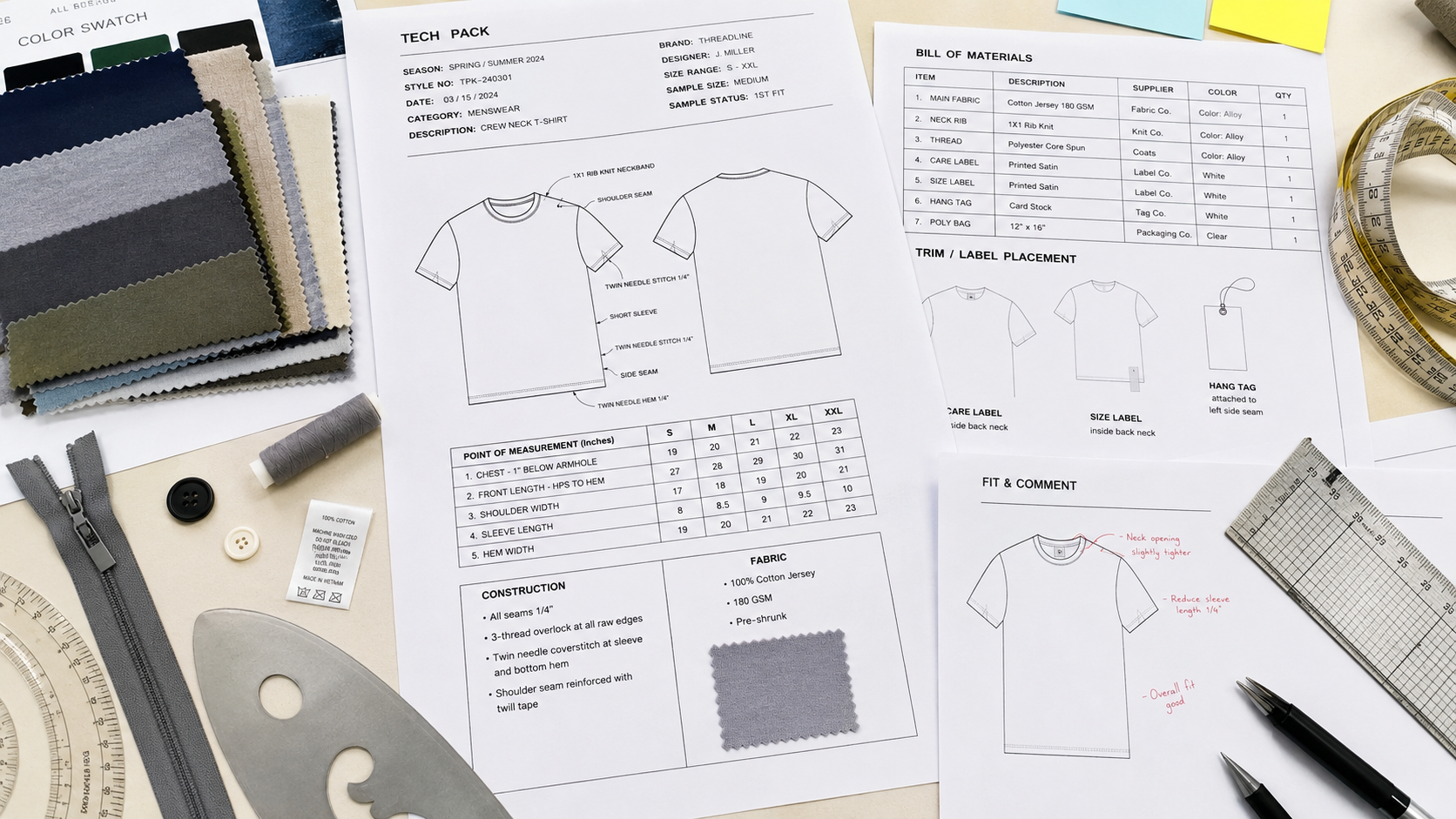
Front and back flat drawings with all construction details visible: seam lines, stitch types, pocket placement, closures, topstitching, and any design elements that affect how the garment is assembled. These are not fashion illustrations. They are engineering documents.
Graded measurements
A complete measurement chart with the base size and all graded sizes, including points of measure (chest, waist, hip, inseam, shoulder, sleeve length, and any garment-specific measurements), tolerances, and how the garment should be measured (flat or on form).
Fabric specification
Fiber content, weight (GSM), weave or knit structure, stretch and recovery if applicable, color reference (Pantone or lab dip), and any performance requirements (moisture wicking, UV protection, antimicrobial treatment). "Cotton" or "polyester blend" is not a specification.
Trim and hardware details
Every component beyond the main fabric: buttons, zippers, elastic, drawcords, snaps, rivets, labels (woven, printed, heat transfer), hang tags, size tabs, care labels, and branded elements. Each needs a material specification, color reference, size, and placement location.
Construction notes
Seam types and allowances, topstitching specifications, interfacing placement, lining requirements, hemming method, and any construction details that are not obvious from the technical drawing. This is where the difference between a well-made garment and a commodity one gets documented.
Bill of materials
A complete list of every material and component required to produce the garment, with quantities per unit, supplier references where available, and color specifications. The BOM is what the factory uses to cost the garment and source materials. Without it, quoting is imprecise and material sourcing starts late.

The Difference Between Design Documentation and Production Documentation
Many buyers approach production with documentation that was created for internal design review rather than for factory execution. The distinction is important because a document that communicates the designer's vision to a merchandising team does not necessarily communicate what a pattern maker, cutter, or sewing operator needs to produce the garment.
Design-stage documentation
Fashion illustrations or CAD sketches showing the garment's visual intent. Color palette references. General fabric direction ("lightweight woven," "stretch knit"). Mood boards and reference images. Approximate sizing based on a sample size. These are useful for internal alignment but do not contain enough detail for factory quoting or production.
Production-ready documentation
Technical flat drawings with all construction details annotated. Graded measurement charts with tolerances across the full size range. Specific fabric and trim specifications with weight, composition, and color references. Bill of materials with per-unit quantities. Construction notes covering seams, stitching, interfacing, and finishing. Packaging and labeling instructions.
The gap between these two stages is where production problems originate. A factory working from design-stage documentation fills in the gaps with its own assumptions about construction, materials, and finishing. Those assumptions may not match the buyer's expectations, and the mismatch typically surfaces during sampling or, worse, during bulk production when corrections are expensive and time-consuming.
What Happens When Incomplete Documentation Reaches the Factory
Incomplete tech packs do not simply slow things down. They create specific, predictable problems that compound as the program moves from sampling through bulk production. Understanding these failure modes is useful context for buyers who are deciding how much to invest in documentation before approaching a production partner.
Inaccurate pricing
Without a complete BOM and construction specification, the factory estimates rather than calculates. The quote may be too low (creating a margin problem when the actual construction is more complex than assumed) or too high (because the factory builds in a buffer for the uncertainty). Either way, the price does not reflect the actual garment.
Extended sample cycles
Missing specifications mean the first sample is partly a guess. The buyer rejects it, provides corrections, and the factory revises. Each round costs time and money. A tech pack that specifies everything clearly on the first submission can reduce sample rounds from three or four to one or two.
Construction ambiguity at scale
A factory that produced an acceptable sample from incomplete documentation may not reproduce the same result in bulk. The sample was supervised closely. Bulk production runs on the specification, and if the specification is vague, different operators interpret it differently across the production run.
Grading failures across the size range
A tech pack with measurements for one sample size and no grading forces the factory to grade the pattern itself. Factory grading may not match the buyer's fit intent, particularly at the ends of the size range where proportional relationships change. This is especially problematic for fitted garments like dresses, blazers, and tailored tops.
A factory working from incomplete documentation fills in the gaps with its own assumptions. Those assumptions may not match your expectations, and the mismatch typically surfaces at the worst possible moment.
What Buyers Should Have Ready Before Approaching a Production Partner
The qualification process for scaled apparel production moves fastest when the buyer arrives with documentation that the factory can use immediately. This does not mean every detail must be finalized before the first conversation, but it does mean the core specification should be far enough along that pricing and sampling discussions are grounded in real information rather than rough estimates.
Ready for a production conversation
Finalized tech packs with technical drawings, graded measurements, fabric and trim specifications, construction notes, and a bill of materials. Target quantity by style and colorway. Size ratio. Desired delivery timeline. Shipping destination. Any compliance or certification requirements relevant to the destination market.
Not yet ready for production
Reference photos without technical drawings. A single sample size without grading. General fabric direction without specific composition, weight, or color references. No bill of materials. No quantity target. These are signs that the program needs more development work before a factory can engage productively.

A note on tech pack creation
Pham Fashion House is not a tech pack creation service. We work with buyers who have production-ready documentation or who are working with a product development team to get there. For buyers who need help developing tech packs, freelance technical designers and product development consultants can help bridge the gap between design intent and factory-ready specifications.
How Pham Fashion House Uses Tech Pack Documentation
Pham Fashion House is a New York-based apparel sourcing and production partner with operations in Vietnam. When a buyer submits a tech pack, our production team reviews the specification to assess factory fit, estimate material sourcing requirements, identify any gaps or ambiguities that need clarification before sampling, and match the program to the right production environment based on garment category, construction complexity, and volume.
Our production network uses Centric PLM for product lifecycle management, which means the approved tech pack specification is stored in a structured system that carries through sampling, production, and any subsequent repeat orders. This is particularly important for repeat production programs where consistency across orders depends on having a locked, retrievable specification rather than a file sitting in someone's email.
For buyers evaluating Vietnam production across specific categories, our guides to formal wear, dresses and blouses, outerwear, custom uniforms, and performance apparel cover the category-specific documentation requirements that go beyond a standard tech pack. For a broader overview of factory evaluation, our guide to choosing an apparel manufacturing partner in Vietnam covers the full process.
Vietnam apparel production partner
Have production-ready tech packs and serious volume?
Pham Fashion House works with established brands and institutional buyers whose documentation is ready for factory review. Programs typically start at 3,000+ units per style.
Discuss Your Program