Women's apparel manufacturing covers more construction complexity than most factory generalizations suggest. From structured suiting that requires precise bust shaping and grading across a full size run to dresses and blouses where silhouette consistency is the central production challenge, this category demands a different kind of factory discipline than men's wear. For department stores, specialty retailers, wholesale buyers, and private label brands evaluating Vietnam for women's apparel production, understanding what the category actually requires is the starting point.
Vietnam has developed significant capability in women's formal wear, suiting, dresses, and woven tops, driven by export programs for international retailers and the broader depth of the country's garment manufacturing infrastructure. This guide covers the categories, the construction considerations, the buyer profiles, and what buyers need before approaching production.

Who this guide is for
This article is written for department store buyers, specialty retailers, wholesale buyers, and private label brands evaluating Vietnam for women's apparel production. It covers formal wear and suiting, work and occasion dresses, and woven blouses and tops at commercial scale, typically 1,000 or more units per style. For men's formal wear production, see our men's formal wear manufacturing guide.
Why Women's Apparel Manufacturing Is Its Own Category
Women's apparel manufacturing is not a variant of men's wear production with different measurements. The construction disciplines are distinct, the grading is more complex, and the silhouette requirements across a women's size run introduce variables that do not exist in the same way in men's garments. A factory with strong capability in men's suiting does not automatically have the pattern making expertise, fitting room experience, or grading knowledge to execute women's structured garments consistently.
The primary technical difference is shaping. Women's structured garments require bust shaping, waist suppression, and hip accommodation that are built into the pattern engineering rather than achieved through padding or standardized blocks. A women's blazer that fits correctly on a size eight needs to have been graded in a way that maintains those proportional relationships across a size four and a size sixteen. Getting that grading right, and verifying it holds through the full size run rather than just at the fit sample size, is one of the most significant production challenges in this category.
For dresses and blouses, the construction challenges shift. Silhouette consistency, fabric drape across a range of body types, and the relationship between lining and shell across multiple sizes all require factory experience specific to this category. The buyers who end up with quality problems in women's apparel production are most often those who selected a factory based on general capability rather than demonstrated experience in the specific category.
The Categories This Guide Covers
Women's suiting and tailored blazers
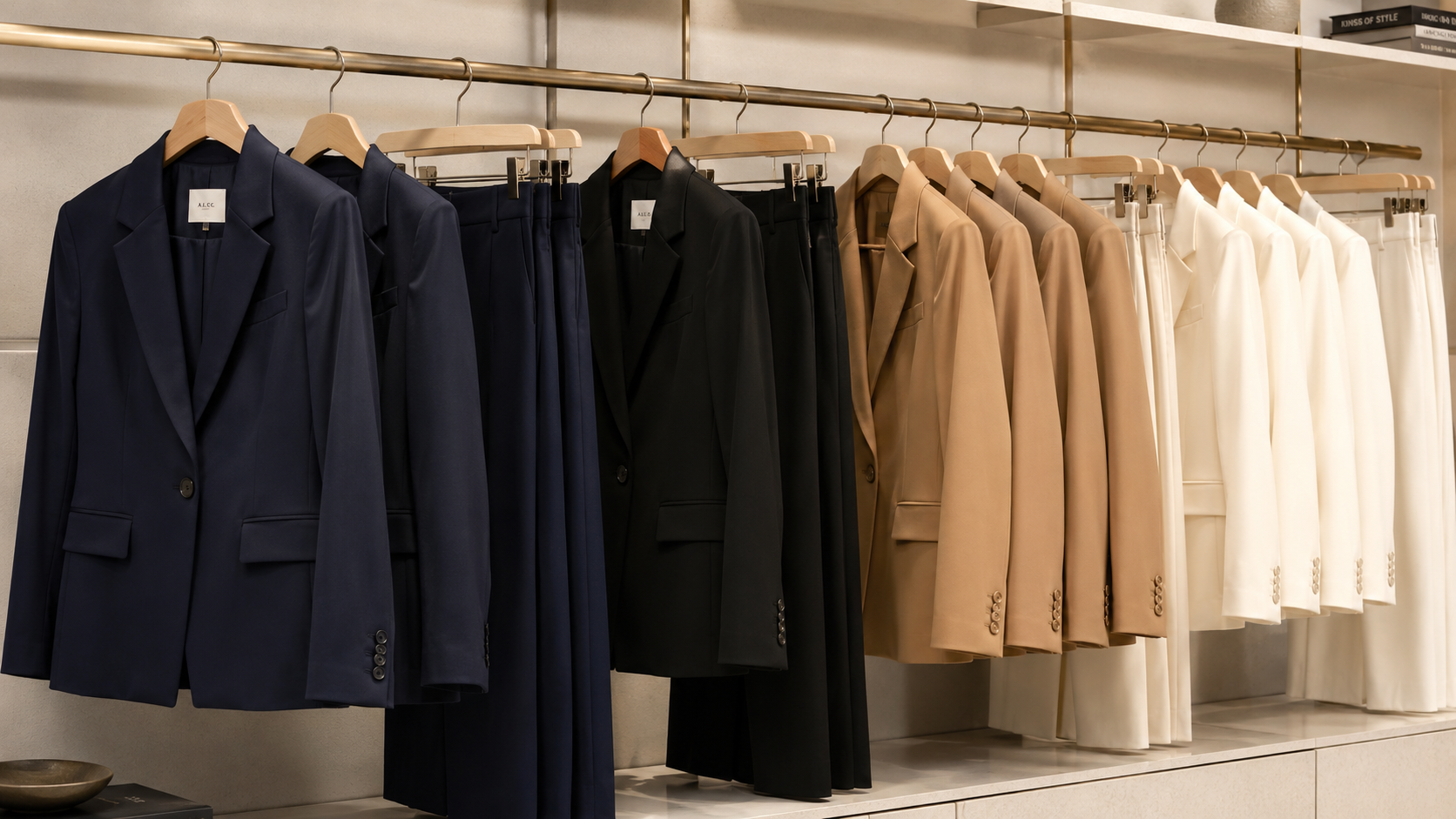
Single and double-breasted blazers, suit jackets, and tailored jackets in structured fabrications. Bust shaping, precise dart construction, and consistent grading across a full women's size range are the defining production requirements.
Suit separates and trouser programs
Tailored trousers, suit skirts, and coordinated separates. Waist and seat grading, crease behavior, and hem finishing specific to women's trouser production require factory experience in this sub-category.
Work and smart casual dresses
Structured shift dresses, wrap dresses, sheath dresses, and office-appropriate day wear. This is the largest volume category for department store and wholesale buyers and requires consistent silhouette across a broad size range.
Occasion and evening dresses
Cocktail, formal occasion, and event wear. Higher finishing standards, specialty fabrications, and decorative detailing add construction complexity compared to day wear. Lining quality and attachment are particularly important in this sub-category.
Blouses and woven tops
Dress shirts, silk-style blouses, structured woven tops, and button-front tops. Collar and cuff construction, placket finishing, and consistent fit across sizes are the primary production requirements.
Outerwear and structured jackets
Women's coats, topcoats, and structured outerwear in suiting-weight and heavier fabrications. Construction complexity increases with garment length and interlining requirements specific to women's outerwear silhouettes.
Construction Considerations Specific to Women's Wear
The construction disciplines that define quality in women's apparel are different from those in men's wear and need to be evaluated separately when assessing a factory's capability. A factory visit or sample review that does not specifically test the areas where women's garments fail is not a meaningful capability assessment.
Structured garments: what to evaluate
Bust shaping accuracy across sizes, not just the fit sample size. Dart placement consistency. Waist suppression that holds its shape after wear and cleaning. Shoulder construction specific to women's blazer silhouettes. Lining attachment that allows movement without pulling. Grading documentation that shows how proportions were maintained across the full size run.
Dresses and blouses: what to evaluate
Silhouette consistency across sizes, particularly at the waist, hip, and hem. Fabric drape behavior across different body types. Lining quality and how it interacts with the shell fabric under movement. Seam finishing inside unlined garments. Collar and cuff construction in blouses. Zipper placement and finishing quality in fitted dresses.
Pattern making for women's wear is where the capability gap between factories becomes most visible. A factory that uses standardized blocks rather than pattern-making specific to the design will produce garments that fit the block, not the intended silhouette. For buyers developing their own women's apparel programs, working with a production partner who can evaluate pattern quality before sampling begins saves significant development time and cost.
Fabric Considerations for Women's Apparel Programs
Fabric selection in women's apparel affects silhouette, drape, construction ease, and how the garment ages through wear and cleaning. The range of fabrics used across women's formal wear, dresses, and blouses is significantly broader than in men's suiting, and each fabric type introduces different production requirements.

Wool and wool-blend crepe
The workhorse of women's suiting and work dress programs. Wool crepe holds shape, drapes well, and accepts tailoring. Pre-shrinkage treatment and pressing discipline throughout production are essential. Commercial colorways in navy, black, camel, and grey are reliably sourceable in Vietnam.
Stretch suiting fabrics
Poly-blend and wool-blend stretch suiting has become a dominant fabric in women's workwear programs. Recovery after wear and cleaning, and consistent stretch behavior across production, need to be confirmed through testing before bulk commitment.
Ponte and double knit
Ponte is a primary fabric for women's work dresses and structured knit programs. Its stability and body-skimming behavior make it a reliable volume fabric. Consistent weight and composition across dye lots are the primary sourcing discipline.
Silk-style and woven dress fabrics
Crepe de chine, charmeuse, and polyester silk-like fabrics are used across blouses, occasion dresses, and dress linings. Handling at the cutting stage requires experience, as bias behavior and slippage can create consistency problems at scale.
Chiffon and lightweight wovens
Used in blouses, overlay details, and evening wear. Chiffon and lightweight wovens require specific cutting and finishing techniques. Seam finishing quality is more visible in lightweight fabrics and needs to be specified precisely.
Printed wovens and novelty fabrics
Print placement consistency across sizes is a specific production requirement for printed dress programs. Placement specifications need to be documented in the tech pack rather than left to factory discretion, particularly for engineered prints.
Who Sources Women's Apparel from Vietnam
The buyer profile for women's apparel manufacturing in Vietnam spans several distinct categories, each with different program structures, volume requirements, and production priorities.
Department stores
Large and mid-format department stores sourcing private label or own-brand women's apparel. These buyers typically have established technical standards, defined seasonal programs, repeat production structures, and buying teams with prior manufacturing experience. Volume is meaningful and quality expectations are high.
Specialty retailers
Women's specialty retailers and career apparel brands developing or expanding production programs. These buyers often have clear customer profiles and fit standards that need to be built into the pattern engineering from the start.
Wholesale buyers and distributors
Wholesale buyers sourcing women's apparel programs for distribution to multiple retail accounts. Volume requirements vary but programs typically involve multiple styles across a consistent color and size range, with repeat production built into the sourcing model.
Private label brands
Direct-to-consumer and contemporary brands developing women's apparel ranges. Vietnam production offers a credible quality level with favorable economics compared to European or domestic manufacturing, particularly for brands that have outgrown nearshore production.
Corporate and hospitality programs
Organizations sourcing formal women's staff apparel for front-of-house teams, executive environments, and client-facing operations. These programs combine quality expectations with institutional scale and annual reorder requirements.
Occasion and event wear buyers
Buyers sourcing occasion wear, mother-of-the-bride, and formal event dress programs. These programs are lower volume per style but higher in construction and finishing standards, and typically require factory experience in specialty fabrications.
Why Vietnam Supports Women's Apparel at Scale
Vietnam's export garment sector includes factories with demonstrated capability in women's formal wear, dress programs, and woven tops. That capability has been built through production relationships with European and Japanese retailers who apply rigorous quality and construction standards to their supplier base. The factories that have operated in that environment for a decade or more have the pattern making experience, the grading discipline, and the quality management systems that women's apparel production at scale requires.
For buyers shipping to the EU, Vietnam's EVFTA provides preferential tariff access. The CPTPP covers Japan, Australia, and Canada. For US-bound buyers, Vietnam's current tariff position under Section 122 is competitive relative to alternative production locations, and more favorable than it was through much of 2025. For a category where fabric cost, construction complexity, and size range coverage all push unit prices higher than basics, the trade position can meaningfully affect program economics.
Women's apparel manufacturing is where factory pattern making capability and grading discipline either hold or fall apart across the size run. The difference is visible on the hanger long before it reaches the customer.
What Buyers Need Before Approaching a Women's Apparel Factory

Women's apparel programs have longer development cycles than basics because the construction complexity means that imprecise specifications produce expensive sampling revisions. Buyers who arrive at the production conversation prepared move through development faster, with fewer rounds and more predictable outcomes.
What production partners need from you
Finalized tech packs with graded measurements across the full size run, not just the sample size. Fabric direction including weight, content, and drape requirements. Lining and interfacing specifications. Silhouette references or existing garments that represent the fit standard. Target FOB pricing, size run, quantity by style and colorway, and delivery timeline.
What affects pricing accuracy
Number of sizes in the size run and the complexity of the grade. Fabric sourcing complexity including specialty or certified materials. Construction detail level including dart count, lining type, and closure treatment. Decoration requirements. Whether this is a one-time program or ongoing seasonal production with repeat structure built in.
Reference garments are particularly valuable in women's apparel. If a buyer has an existing garment that represents the construction standard, silhouette, or fit they are targeting, sharing it during development reduces interpretation error and shortens the sample approval cycle. In a category where one grading decision cascades through multiple quality issues, clear reference material is a meaningful efficiency gain.
How Pham Fashion House Supports Women's Apparel Programs
Pham Fashion House is a New York-based apparel sourcing and production partner with operations in Vietnam. Our production network includes factory partners with demonstrated capability in women's formal wear, suiting, dress programs, and woven tops. We support the full production process from factory matching and fabric sourcing through sampling, construction oversight, quality inspection, and export documentation.
We work with department stores, specialty retailers, wholesale buyers, private label brands, and institutional programs across North America, Europe, Japan, Korea, Australia, and other markets. Programs we work on are typically 1,000 or more units per style, and buyers should come to the initial conversation with tech packs, fabric direction, size run, quantity targets, and a production timeline.
For buyers also evaluating men's formal wear or structured garment production, our men's formal wear manufacturing guide covers the construction disciplines specific to that category. For context on Vietnam production more broadly, our China vs Vietnam manufacturing comparison and our Vietnam garment manufacturing guide for scaled production provide useful sourcing context. Buyers evaluating Vietnam for the first time may also find our guide to choosing an apparel manufacturing partner in Vietnam a helpful starting point.
Women's apparel production partner
Planning a women's apparel program in Vietnam?
Pham Fashion House supports department stores, specialty retailers, wholesale buyers, and private label brands producing women's formal wear, dresses, and blouses in Vietnam. Programs typically start at 1,000+ units per style.
Discuss Your Program