Performance Apparel Manufacturing in Vietnam: Activewear, Technical Knits, and Scaled Production
Performance apparel manufacturing takes more than sewing capacity. Technical fabrics, stretch materials, bonded finishes, and performance claims all need the right sourcing, sampling, testing, and production controls to deliver consistent results at scale. For buyers producing activewear, compression garments, performance uniforms, and workwear at volume, getting those disciplines right is what separates a program that holds up from one that creates ongoing quality problems.
Vietnam has built significant capability in performance and technical apparel production, anchored by factories with a confirmed production history across major international activewear and performance brands. This guide covers what the production network offers, what buyers need before approaching production, and how fabric sourcing and testing determine whether a program performs consistently at volume. For technical outerwear programs involving waterproof membranes, seam sealing, and GORE-certified construction, our outerwear manufacturing guide covers those capabilities in detail.

Who this guide is for
This guide is for activewear brands, athletic apparel companies, performance uniform buyers, and workwear programs planning production in Vietnam. The production disciplines covered are most relevant for programs of 3,000 or more units per style, where fabric consistency, technical performance, and quality repeatability are the primary requirements.
Why Performance and Technical Apparel Thrive at Scale
Performance fabrics including moisture-wicking synthetics, stretch weaves, recycled polyesters, and technical knits deliver more consistent results when production is managed at meaningful volume. Larger runs allow factories to maintain tighter cutting tolerances, more consistent tension, better dye lot management, and more structured quality checkpoints across the full order.
At lower quantities, small variations in fabric behavior, trim application, or sewing tolerance are harder to control because the production process has less room to standardize. At 3,000 or more units per style, Vietnam's export-focused production lines can support automated cutting, precise finishing, and repeatable quality protocols that technical apparel requires.
This consistency matters most for activewear, performance uniforms, compression garments, and workwear, where fit, durability, and function define the product rather than styling alone. A garment that performs correctly in a sample but drifts in bulk is not a sampling problem. It is a production discipline problem, and the disciplines that prevent it are covered in our quality control and inspection guide.

Performance Fabric Categories That Work at Scale in Vietnam
Vietnam's textile and garment ecosystem supports a wide range of performance fabric categories. The key for buyers is not simply finding a fabric that looks right in a swatch. It is confirming that the material performs consistently through sampling, washing, testing, and bulk production at the scale and care conditions the finished garment will actually face.
Recycled polyester and nylon blends
Four-way stretch blends in recycled polyester and nylon perform well across activewear, performance uniforms, and technical layering. Sourcing certified recycled content (GRS or Recycled Blended Claim Standard) adds lead time and requires verification through the supply chain.
Antimicrobial and odor-resistant fabrics
Treatments need to be evaluated for durability across repeated industrial wash cycles, not just initial performance. Treatment longevity should be confirmed through lab testing before bulk commitment.
Lightweight breathable fabrics with UPF protection
UPF-rated fabrics are well suited to outdoor performance, athletic, and workwear applications. Protection ratings should be confirmed through certified testing rather than fabric spec sheets alone.
Softshell and technical fleece
Layering constructions for midlayers and technical casual programs. Bonded and laminated constructions require factories with specific bonding capability and experience managing delamination risk in sampling.
Sustainable performance blends
Organic cotton and other certified materials blended with performance fibers. GOTS and Organic Blended Content Standard certification requirements, sourcing availability, and lead times need to be confirmed early in development.
Technical knits and jersey
Four-way stretch jersey, compression fabrics, and structured technical knits support activewear and performance uniform programs. Stretch recovery, fabric weight consistency, and print adhesion all require specific production controls.
For programs where fabric sourcing and material certification are central to the product's market positioning, our sustainable fabric sourcing guide covers what is available through Vietnam's supply chain and what requires advance planning.

What Buyers Need Before Approaching Performance Apparel Production
Performance apparel programs require more upfront alignment than basic cut-and-sew garments because the fabric, fit, construction method, and testing requirements all interact. Buyers who come to the production conversation with finalized specifications move through development faster and with fewer costly revisions. Our tech pack guide covers what a production-ready specification package should contain.
Finalized fabric selections
Performance fabrics often require longer sourcing lead times, particularly for certified, recycled, or custom-developed options. Fabric direction should be confirmed before sampling begins, not during it.
Physical samples and lab reports
Request fabric samples and lab test reports before committing to bulk. Shrinkage, colorfastness, stretch recovery, and seam strength should all be confirmed under the garment's actual use and care conditions.
Clear technical specifications
Seam strength requirements, stretch recovery tolerances, wash testing protocols, shrinkage limits, and colorfastness standards should all be defined in the tech pack before sampling, not negotiated after.
Grading and size scaling
Performance garments require precise grading to maintain fit and function across the full size run. A size medium that performs correctly does not automatically mean a size XL or XS will behave the same way without careful grade review.
Trims, finishes, and compliance
Zippers, drawcords, reflective trims, labels, hangtags, and packaging all affect timeline and cost. Compliance requirements for specific markets or retailers should be confirmed before production begins.
Sealed approved samples
A sealed pre-production sample for each style serves as the reference standard for all subsequent production inspections. In performance apparel, where function is as important as appearance, the sample approval process is not a formality. Our sampling guide covers the full development sequence.
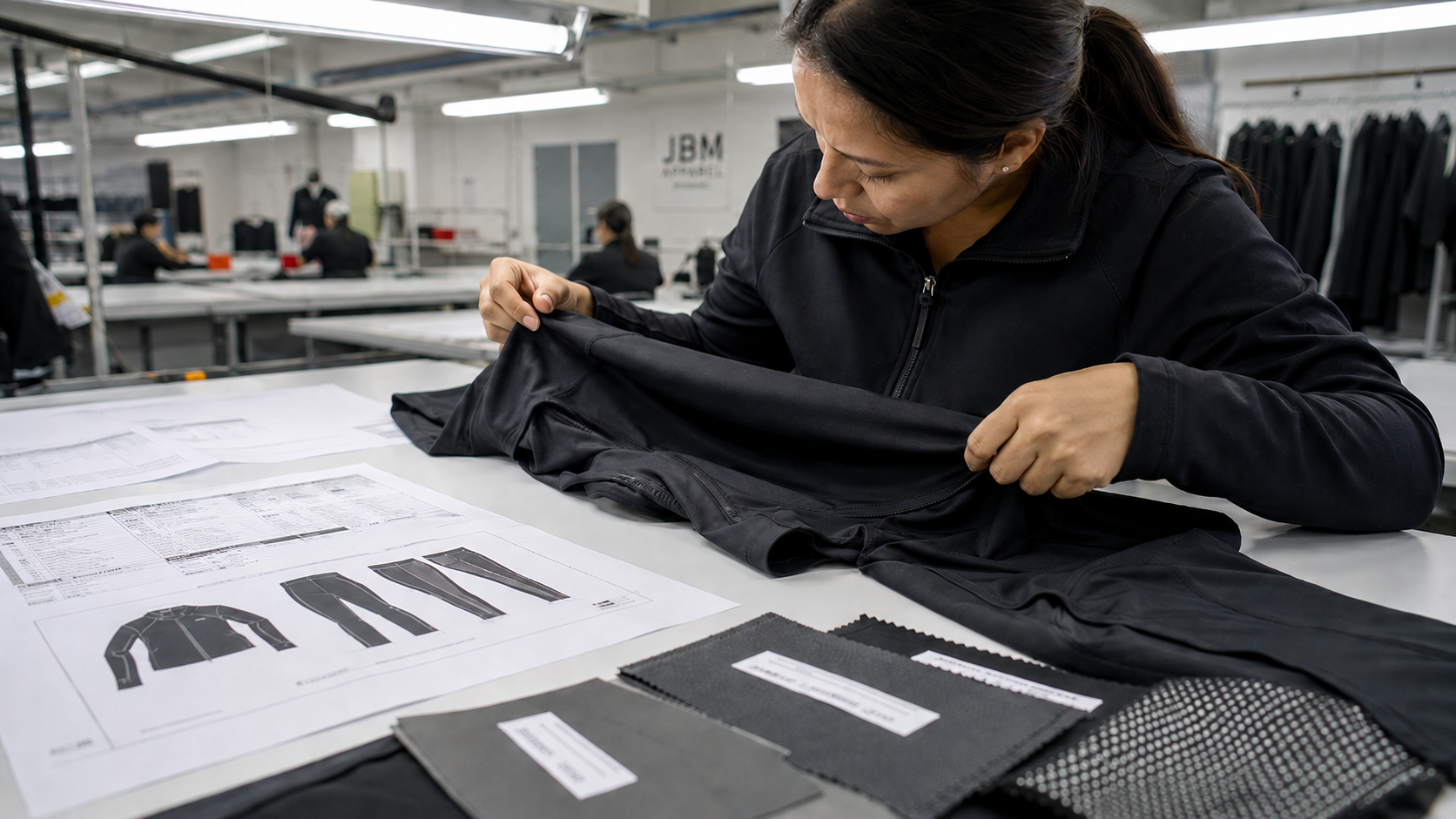
What the Vietnam Production Network Delivers for Performance Apparel
Vietnam's performance apparel manufacturing capability is concentrated in export-focused facilities with decades of experience producing for international activewear and athletic brands. Our production network includes factories with a confirmed client history across brands such as Under Armour, Adidas, The North Face, Patagonia, and Oakley, alongside institutional uniform and workwear programs for Walmart, Costco, and Target.
Knitted product capacity across the network reaches 2 million pieces per month, covering the technical knit categories that most activewear and performance programs require: jersey, interlock, rib, fleece, terry, pique, and engineered stretch fabrics. Woven capacity supports performance trousers, shorts, and hybrid constructions at comparable scale.
Technology and development infrastructure
Pattern development and grading use Gerber Design Technology and 3D Optitex virtual sampling, which allows fit review and construction validation before physical samples are cut. For performance apparel, where stretch behavior and compression mapping vary across sizes, 3D development reduces the number of physical sample rounds and catches grading problems earlier in the process.
Costing runs through GSD (General Sewing Data), a time-study system that builds standard minute values for each operation in a garment's construction sequence. For buyers comparing quotes across factories or evaluating whether a price reflects the actual construction complexity, GSD-based costing provides a transparent foundation. Our costing and FOB guide covers how to read and verify a factory quote.
In-house testing and quality infrastructure
The production network operates an in-house laboratory for textile and garment testing, covering the core performance metrics that define whether a technical garment holds up across its use life: shrinkage, colorfastness, seam strength, pilling resistance, stretch recovery, and fabric weight consistency. Tests that fall outside the in-house scope route to independent accredited laboratories.
Smart fabric inspection systems apply the 4-point grading method at the roll level before fabric enters the cutting room, catching defects, shading inconsistencies, and weight variation before they propagate through a production run. For performance fabrics where dye lot consistency and stretch uniformity are critical, this inspection layer is especially important.
The facility certification stack includes BSCI, WRAP, SA8000, ISO 9001:2015, Higg Index, SMETA, Global Recycled Standard, GOTS, and Organic Blended Content Standard, among others. These certifications sit at the facility level and are verified through scheduled third-party audits. For programs where the buyer's compliance team or retail partner requires specific audit credentials, the certification scope should be confirmed during factory evaluation. Our factory audit and compliance guide covers how to evaluate a factory's compliance standing.
Trade position
Vietnam's network of free trade agreements provides preferential tariff access for performance apparel across the EU (EVFTA), the UK (UKVFTA), Japan, Canada, Mexico, and Australia (CPTPP), the UAE (CEPA), Israel (VIFTA), South Korea (VKFTA), and the broader Asia Pacific region (RCEP). For U.S.-bound shipments, a permanent 12.5% Section 301 duty applies on top of standard MFN rates. Current rates by market, garment category, and the rules of origin required to qualify for preferential treatment are tracked in our tariff guide and our FTA market access guide.

In performance apparel, the fabric and the construction are the product. Getting both right before bulk begins is not optional.
How Pham Fashion House Supports Performance Apparel Programs
Pham Fashion House is a New York-based apparel sourcing and production partner with operations in Vietnam. We work with activewear brands, athletic apparel companies, performance uniform programs, and workwear buyers producing technical garments across North America, Europe, Japan, Korea, Australia, the Middle East, and other markets.
We support the full production process from factory matching and fabric sourcing through sampling coordination, tech pack review, quality control, and export documentation. Our production network includes factory partners with demonstrated capability in technical fabric handling, performance garment construction, and quality management for international buyers producing at scale.
For buyers evaluating Vietnam production across multiple garment categories, our guide to choosing an apparel manufacturing partner covers how to evaluate factory capabilities, and our lead times guide covers what to expect from development through delivery. For programs that combine performance apparel with waterproof or membrane-bonded outerwear, our outerwear manufacturing guide covers the additional capabilities and certifications those categories require.
Vietnam Apparel Production Partner
Planning a performance apparel program in Vietnam?
Pham Fashion House supports activewear brands, athletic buyers, and performance uniform programs producing technical garments in Vietnam. We work across activewear, compression, performance knits, technical uniforms, and workwear, typically for programs of 3,000+ units per style.
Get a Production Assessment