How to Choose an Apparel Manufacturing Partner in Vietnam
Choosing an apparel manufacturing partner in Vietnam is a bigger decision than finding a factory that can sew the product. The right partner should understand your garment category, order volume, material needs, quality expectations, and long-term production goals.
For many brands, the search begins with a familiar phrase: "Vietnam garment manufacturer," "garment manufacturing Vietnam," or "Vietnam clothing factory." Those searches produce a shortlist, and the shortlist produces three quotes with three delivery dates, which is where most evaluations stall. A quote can only be compared with another quote when both were built on the same assumptions, and a lead time means very little until you know where it starts.
Established brands, uniform programs, healthcare apparel companies, hospitality groups, retailers, and formal wear buyers often need more than a supplier list. They need a production path that can support clear communication, reliable sourcing, consistent quality, and repeatable execution.

Start With Product Fit
Not every apparel factory is right for every garment. Some factories are stronger in knits, while others are better suited for woven garments, uniforms, outerwear, performance apparel, structured formal wear, or healthcare apparel. Some are built for basic styles at volume. Others are more comfortable with detailed construction, special trims, technical fabrics, or more complex finishing.
Before choosing a manufacturing partner in Vietnam, buyers should be clear about the type of product they want to make. A scrub top, hospitality uniform, performance polo, woven blouse, tailored jacket, structured blazer, and branded retail garment all require different sourcing decisions, production planning, and quality checks. For buyers evaluating specific categories, our guides to formal wear manufacturing, hospitality uniform manufacturing, and medical apparel manufacturing cover those verticals in detail.
A good partner should be honest about factory fit. The goal is not to force every product into the same production environment. The goal is to match the product with a factory that has the right experience, equipment, workforce, and quality process.
Product fit comes first
The best Vietnam apparel manufacturing partner is not always the largest factory or the cheapest quote. It is the partner that understands what your product requires and can help place it in the right production environment.
Make Sure Your Tech Packs Are Production-Ready
Clear documentation makes the manufacturing process much easier. Before a factory can quote accurately or develop a reliable sample, it needs to understand the garment in detail.
A production-ready tech pack usually includes technical drawings, graded measurements, construction notes, fabric specifications, trim details, label placement, packaging instructions, size ratios, and a bill of materials. These details help reduce back-and-forth and make it easier to compare quotes from different production options.
For brands producing at scale, this preparation becomes even more important. A small measurement issue, unclear trim requirement, or vague fabric description can create larger problems once production moves beyond sampling.
Once your tech packs are finalized, the pricing conversation moves quickly. Our guide to apparel costing and FOB pricing from Vietnam covers what the quote contains, which factors move the number, and how to prepare so the price you receive holds at production.

How to Compare Quotes From Three Factories
The request behind most sourcing shortlists is simple enough: three quotes, side by side, with lead times attached. What arrives is three numbers built on three sets of assumptions, and comparing them as they stand rewards whichever factory assumed the least.
Normalization comes first. A quote has to be restated on common terms before the difference between two quotes means anything.
A quote is a set of assumptions with a number attached
Two factories pricing the same tech pack can land far apart without either one being wrong, because they have costed different fabric, different consumption, different packing, and different quantities. The comparison becomes possible once those assumptions are visible.
What to normalize before comparing
The Incoterm
FOB, FCA, CIF, and DDP describe different scopes of responsibility. An FOB price and a DDP price are not comparable figures, since the DDP number carries freight, duty, and delivery inside it. Ask every factory to quote the same term.
The fabric, named
Which quality, from which mill, at what price per metre, with what consumption per garment. Two of those four are usually missing from a quote, and together they account for most of the spread between competing numbers.
Quantity and colorway split
A price at 10,000 units in one color is a different price from 3,000 units across three colors, because dye lots, cutting efficiency, and line setup all move. Confirm the quantity and split each quote assumes.
Trims and packing
Thread, interlining, labels, hangtags, polybags, cartons, and whether goods arrive ratio-packed or solid. Packing detail is a common exclusion and a real cost, and it surfaces late when it is left out.
Sampling, testing, and inspection
Whether development samples, fabric and garment testing, and final inspection sit inside the unit price or arrive later as separate charges. Our guide to the Vietnam sample development process covers what the sampling stage involves.
Payment terms and validity
A deposit percentage changes the working capital an order consumes, which is part of the cost even though it never appears in the unit price. A quote without a validity date is a number that can move before the order is placed.
How a low quote gets low
The cheapest of three quotes frequently assumed a lighter fabric, understated consumption, generic trims, no testing, excluded packing, or a higher quantity than the order will actually carry. That is rarely deception. A factory answering an incomplete question fills the gaps with its own defaults.
What normalization changes
Restated on one Incoterm, one named fabric, one quantity, and one packing standard, the spread between three quotes usually narrows considerably. What remains is the difference worth understanding, and it is often somewhere nobody was looking.

What Drives Price Differences Between Factories
Once quotes sit on common terms, the remaining differences come from a small number of places. Labor rate is rarely the largest.
Fabric sourcing
Fabric is usually the largest single component of an FOB price, so a factory's mill relationships and buying volume move the number more than its sewing rate does. A factory that books a quality regularly buys it better than one sourcing it for the first time.
Minutes per garment and efficiency
Every style carries a standard time to produce. Two factories with the same wage bill reach different costs when one runs at higher efficiency, because the same minute costs less when more of it becomes finished product.
Line setup and changeover
A style that occupies a line for a week absorbs setup cost differently from one that runs for a month. Order size relative to line capacity is part of the price, which is why the same style quotes differently at two factories of different scale.
Vertical integration
Washing, embroidery, printing, and heat transfer handled in house carry different cost and timing than the same operations subcontracted out and trucked between sites. Ask which operations leave the building.
Compliance and facility tier
Audited facilities, certifications, in-house laboratories, and documented systems cost money to maintain, and that cost sits inside the price. A quote well below the others sometimes indicates a factory carrying less of it. Our guide to factory audits and compliance covers what to verify.
What the price includes
Testing, inspection, documentation, and sample costs either sit in the unit price or arrive separately. A quote that covers all of them reads worse on the spreadsheet and better at settlement.
The lowest quote and the lowest cost are frequently different factories. The gap between them is made of everything the cheaper quote left out.
What a Quoted Lead Time Includes and Excludes
Lead time is the number most often quoted with the least definition. A factory saying ninety days may mean ninety days of production, or ninety days from order confirmation, or ninety days from the moment approved fabric reaches the cutting floor. Those are different commitments, and the difference between them can run to a month or more.
One question resolves most of the ambiguity: does the lead time start at order confirmation or at fabric in-house? A factory that answers precisely, with the materials block named separately, is describing a plan. A factory that answers loosely is describing a hope.
Sampling and approval
Development and fit rounds, then the production sample. Approval loops move at the speed the buyer responds, which is why they usually sit outside a quoted lead time and still consume calendar.
Materials
Fabric booking, knitting or weaving, dyeing and finishing, plus trims arriving from several suppliers. Frequently the longest single block in the schedule, and the one most often left out of the quoted figure.
Production
Cutting, sewing, and finishing. This is the part most factories mean when they quote a number, and on many programs it is a minority of the total elapsed time.
Testing and inspection
Garment testing and final inspection sit after production and before shipment. A failed inspection means rework inside the same window, so the schedule needs room for one round of it.
Documentation and booking
Export documentation, container booking, and cutoff dates at port. A vessel missed by one day commonly costs a week.
Transit
Ocean freight from Vietnam to the United States or Europe, plus inland movement to the receiving location. Air freight compresses this and changes landed cost enough to affect the decision.
Capacity is the other half of a delivery date
A delivery date depends on when the order enters the production plan as much as on how long the work takes. Booking a line during peak season, or in the weeks around Tet, produces a different answer from booking the same style in a quiet month. Ask when the order would be scheduled, not only how long it would take once it starts.
For stage-by-stage timing, our guide to apparel production lead times in Vietnam sets out how long each block usually takes and where schedules slip.
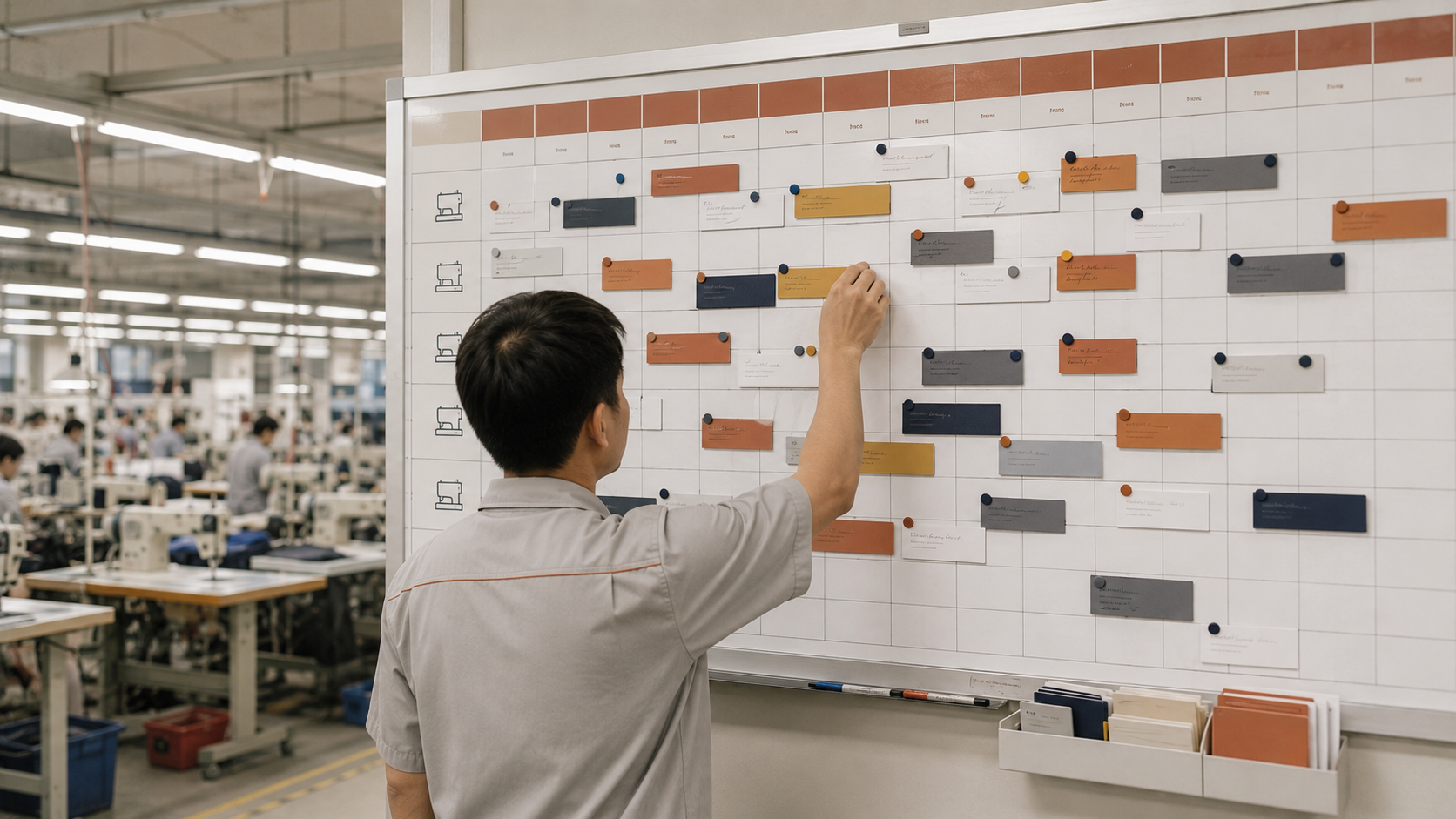
Questions That Separate a Real Answer From a Reassuring One
Most factories answer capability questions the same way, which makes the choice of question the useful part. These are the ones where answers actually diverge.
"Which of my styles would you rather not make?"
A factory willing to name a style outside its strength is telling you where its experience sits. A factory comfortable with everything on the range has told you nothing.
"Does the lead time start at order confirmation or at fabric in-house?"
A precise answer with the materials block separated out indicates a factory that plans in stages. A single number covering everything usually hides the fabric.
"What happens when the approved fabric is short or unavailable?"
The answer should describe a written change request and buyer approval before anything gets booked. Our guide to design protection and fabric substitution covers the controls behind that answer.
"Who are your buyers in my category, and at what volume?"
Category experience at comparable volume predicts more than total capacity does. A factory producing millions of units in categories unrelated to yours has not answered the question.
"What was your on-time delivery rate last season, and what caused the misses?"
A factory that can describe its failures has a system that records them. Ask what changed afterward, because the answer separates a measured operation from a confident one.
"Who will I speak with during production, and in what time zone?"
Names and a working schedule rather than a general assurance. Communication structure decides whether problems get solved early or discovered late.
Understand MOQs Before Sampling
Minimum order quantities are one of the most common points of confusion in apparel manufacturing. They are usually tied to real production economics, including fabric mill minimums, dye lots, cutting efficiency, production line setup, trims, labels, packaging, inspection, and freight.
Very small custom runs can be difficult to produce efficiently because many of the same steps are required regardless of order size. Fabric still needs to be sourced or dyed. Samples still need to be reviewed. Production still needs to be scheduled. Finished goods still need to be inspected, packed, and shipped.
This is why Vietnam manufacturing is often a better fit for brands planning larger production runs, repeat orders, or structured apparel programs. A serious manufacturing partner should be transparent about volume expectations early, before too much time is spent on development.
Strong manufacturing partnerships work best when product requirements, order volume, and production expectations are aligned from the beginning.
Evaluate Sourcing Support
Fabric and trim sourcing can shape the entire production process. A garment may look simple on paper, but the right material choice can affect price, lead time, fit, durability, wash performance, shrinkage, and final hand feel.
A good apparel manufacturing partner should help brands understand what is locally available, what may require special sourcing, and what choices could affect minimums or timelines. This matters for performance fabrics, stretch blends, uniforms, healthcare apparel, workwear, formal wear fabrics, and garments that require specific finish or durability standards.
Larger production programs also need consistency across future orders. If a fabric is difficult to source, likely to change, or unavailable in repeat quantities, the brand should know that before committing to a production plan.
Material availability
The partner should understand whether your preferred fabrics, trims, colors, and finishes are realistic for Vietnam production.
Repeatability
For ongoing programs, the material plan should support future replenishment, not only the first order.
Performance needs
Stretch, durability, shrinkage, moisture management, opacity, and wash performance should be considered early.
Trim consistency
Labels, buttons, zippers, elastic, drawcords, snaps, packaging, and branded details can affect both quality and timing.
Ask How Communication Will Be Managed
Communication is one of the most important parts of overseas apparel manufacturing. Even when a factory is capable, production can become difficult if responsibilities are unclear or updates are inconsistent.
Brands should understand who will manage sample feedback, production questions, timeline updates, material approvals, quality issues, and shipment coordination. This is especially important when working across time zones, languages, and multiple teams.
A strong partner should provide structure. The brand should know what information is needed, what decisions are pending, where production stands, and how issues will be handled if they come up. For buyers evaluating the full transition to Vietnam production, our guide to switching garment production to Vietnam covers communication and production management in detail.

Know When Factory-Direct Works
Working directly with a factory can be the right choice for some brands. This is often true when a company already has experienced production staff, finalized tech packs, established sourcing knowledge, local quality control resources, and a clear process for managing overseas suppliers.
Factory-direct relationships can work well when the brand knows exactly what it needs and has the internal team to manage the process. In those cases, the factory can focus on production while the brand handles sourcing decisions, communication, inspections, documentation, and issue resolution.
The challenge is that many brands are not only looking for sewing capacity. They need help turning a product specification or production plan into something a factory can execute reliably and repeatedly.
Know When a Manufacturing Partner Helps
A manufacturing partner can be useful when a brand needs more support around factory selection, sourcing coordination, sampling, quality control, production oversight, and export logistics.
This model can be especially helpful for brands building a Vietnam sourcing lane for the first time, managing multiple styles, planning repeat orders, or producing apparel where consistency is critical. The partner helps manage the process around the factory relationship so the brand has better visibility and fewer gaps. Buyers comparing Vietnam to other production options may also find our China vs Vietnam manufacturing comparison useful context.
For larger programs, this support can make production more organized and easier to manage. The factory remains essential, but the surrounding coordination is what helps the program run more smoothly.
Factory access is only one part of the decision
A strong Vietnam apparel manufacturing partner should help with factory fit, sourcing, communication, sampling, quality control, documentation, and logistics, not only production capacity.
What Larger Brands Should Prioritize
Larger brands and organizations usually need to think beyond the first production run. They may need repeat orders, consistent sizing, reliable color matching, replenishment planning, packaging standards, and quality control across multiple styles or locations.
This is common for established fashion brands, uniform programs, healthcare apparel companies, hospitality groups, retailers, education programs, and service businesses. These buyers often need apparel that can be produced consistently over time, not only sampled once. For a detailed breakdown of the quality disciplines that make scaled production reliable, our apparel production quality guide covers the full framework.
When evaluating a partner, larger buyers should ask whether the production setup can support that kind of repeatability. The right answer depends on the product, volume, timeline, and level of oversight required.
How Pham Fashion House Supports Apparel Manufacturing in Vietnam
Pham Fashion House supports brands and organizations that want to manufacture apparel in Vietnam with greater confidence. Through our Vietnam manufacturing network and production coordination model, we help clients navigate sourcing, factory fit, sampling, production oversight, quality control, and export-ready production.
We are best suited for clients planning larger garment production runs, repeat programs, or scaled custom apparel orders across uniforms, formal wear, performance apparel, and institutional programs. Our work is focused on helping brands manage the details that shape production outcomes, from fabric and construction to communication, inspection, and logistics.
On pricing and timing specifically, we quote on one defined basis. A price arrives with the fabric named, the consumption stated, the packing standard set, and the Incoterm fixed, and the delivery date separates the materials block from production so the schedule can be checked rather than taken on trust. Because we contract with the factory in our own name, the number we give is the number we are accountable for.
For companies evaluating apparel manufacturing in Vietnam as part of a broader sourcing strategy, the right partner can make the process more organized, more transparent, and easier to manage.

Choosing the Right Partner Starts With Clarity
The best manufacturing conversations begin with clear information. Brands should understand their product requirements, target order quantities, material preferences, size range, timeline, and quality expectations before moving too far into sourcing.
With the right preparation, Vietnam can be a strong manufacturing base for brands planning serious apparel production. The right partner can help turn that opportunity into a more structured and reliable production program.
Vietnam apparel manufacturing
Comparing quotes and lead times for Vietnam production?
Pham Fashion House supports established brands and institutional buyers with apparel sourcing, factory coordination, quality control, and scaled garment production in Vietnam. We quote on a defined basis, with the fabric named and the schedule broken out. Programs typically start at 3,000+ units per style.
Explore Our Services