Formal wear manufacturing is one of the most technically demanding categories in apparel production. A well-constructed blazer, suit, trouser, or structured jacket requires a level of construction discipline, grading precision, and quality oversight that most factories are not equipped to deliver consistently. For retailers, private label brands, and sourcing teams evaluating production partners, choosing the right factory for this category is a fundamentally different decision than sourcing casualwear or basics.
Vietnam has developed significant capability in structured garment production, and for buyers evaluating formal wear manufacturing at scale, it represents one of the strongest options available outside traditional European and East Asian production centers. This guide covers what the category requires from a production standpoint, why suiting size runs drive minimum quantities, and what separates a capable manufacturing partner from a general garment factory.

Who this guide is for
This article is written for retail buyers, private label sourcing teams, merchandising directors, and brand operators planning formal wear production programs at scale. Programs discussed here typically run 3,000 or more units per style, with limited flexibility in select cases depending on fabric, construction, and size run. The considerations covered are specific to structured garment manufacturing and differ substantially from casualwear or performance apparel production.
Why Formal Wear Manufacturing Is a Specialized Category
Formal wear sits at the most technically demanding end of the apparel production spectrum. Where casualwear construction allows wider factory selection and more flexible quality tolerances, structured formal garments require precision at every stage. A blazer that does not hold its shape, a suit jacket where the collar rolls differently on every size, or a trouser where the crease breaks incorrectly are visible failures that a retail buyer or end customer notices immediately.
The production requirements that define this category include canvas construction in structured outerwear, precise pattern engineering across a full size run, lining quality and attachment, lapel shaping and roll, shoulder construction, button stance and placement, and finishing standards that hold up to retail scrutiny. Each of these decisions compounds. A garment where one element is off rarely recovers through the others.
For buyers sourcing formal wear at scale, factory selection is therefore not a commodity decision. The production partner needs demonstrated capability in structured garments rather than the general ability to cut and sew apparel. Those are meaningfully different things, and the difference only becomes visible at bulk.
The Formal Wear Categories Vietnam Supports
Vietnam's formal wear manufacturing capability spans the core categories that retail buyers and private label programs typically require. Understanding where the capability is strongest helps buyers align their program with the right factory profile.
Blazers and sport coats
Single and double-breasted blazers, sport coats, and structured jackets in wool, wool-blend, linen, and performance fabrications. Canvas, half-canvas, or fused construction depending on price point and product specification.
Suits and suit separates
Two and three-piece suits, suit jackets, and coordinated separates programs. Full pattern engineering, precise grading across a size run, and lining construction are the primary technical requirements.
Tailored trousers
Dress trousers, suit trousers, and tailored pants in suiting weights. Waistband construction, crease behavior, seat and thigh grading, and hem finishing all require factory experience specific to this category.
Dress shirts and woven tops
Formal dress shirts, spread and point collar shirts, and structured woven tops. Collar and cuff construction, placket finishing, and consistent fit across a full size range are the defining production requirements.
Structured outerwear
Overcoats, topcoats, formal jackets, and structured outerwear in wool and wool-blend fabrications. Heavier weight construction, interlining, and the structural integrity required for longer garments add complexity relative to lighter categories.
Occasion and event wear
Tuxedos, evening jackets, formal occasion pieces, and event wear. Higher finishing standards, specialty fabrications, and attention to lapel facings, pocket treatments, and button selection distinguish this sub-category.

Why Suiting Size Runs Drive Minimum Quantities
Formal wear carries the widest size architecture in apparel, and it is the single largest reason minimum quantities in this category sit where they do. Buyers coming from knits or casualwear frequently underestimate how far a given quantity has to stretch once it meets a suiting grade.
A menswear jacket program is graded across chest sizes and then again across length classes, so a range running from the mid thirties to the low fifties in short, regular, and long produces well over thirty active size combinations before a single colorway is counted. Suit programs sold as sets add trouser sizing and drop conventions on top of that. A womenswear tailoring program carries a comparable spread once fit variants are included.
That architecture is what turns quantity into a production question. An order of 3,000 units across a thirty-size run averages roughly a hundred pieces per size, which supports efficient marker planning, sensible fabric consumption, and a cutting lay that does not waste suiting fabric. The same range at a third of that volume falls to a few dozen pieces in each size, and the far ends of the run drop into single digits. At that point the factory is effectively making samples in bulk, fabric waste climbs, and unit cost rises rather than falls.
Narrow the size run before narrowing the order
A buyer whose volume falls short of the threshold usually has a better option than reducing quantity, which is reducing the size architecture. A tighter range in the sizes that actually sell, or a program launched in two colorways rather than four, concentrates the same units into producible quantities. Programs frequently become viable through this conversation rather than through an exception to the minimum.
Separately, we periodically hold completed blazer inventory from cancelled production programs, in wool, wool-blend, and stretch-blend fabrications with private-label relabeling available. For buyers who need structured menswear on a timeline that development cannot meet, or at a volume below production minimums, our current blazer inventory is worth a look. Availability changes, and what is listed is what is on hand.
What Separates Quality Formal Wear Production from Standard Garment Manufacturing
The gap between a factory that can produce a blazer and a factory that can produce a blazer consistently, to retail quality, across a full size run, is significant. For buyers evaluating production partners, that distinction matters more in this category than in almost any other.
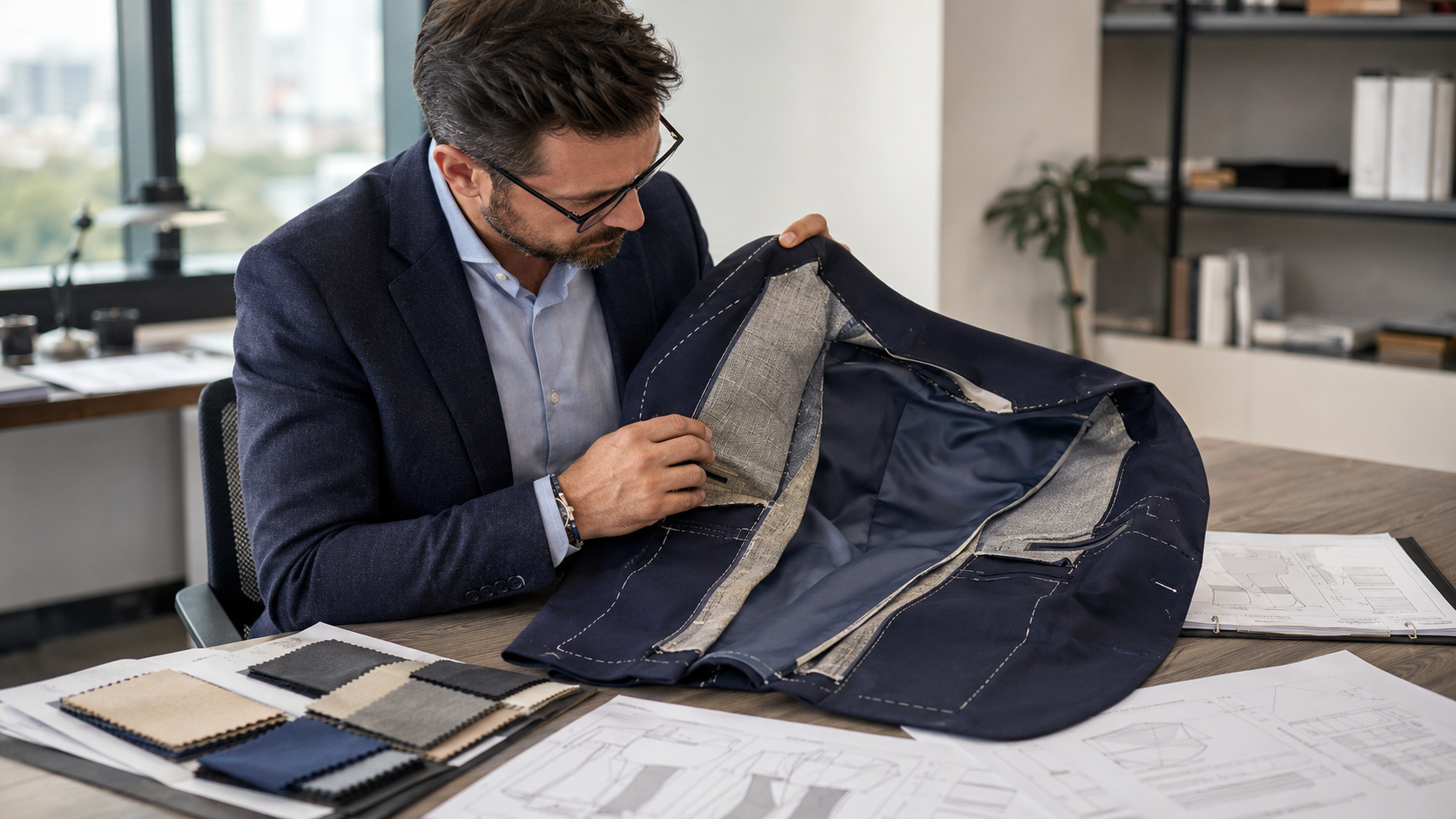
Construction method is the first differentiator. Fully canvassed construction, where a floating canvas is stitched through the front of the jacket, produces a garment that holds its shape, molds to the wearer over time, and maintains its silhouette through repeated wear and cleaning. Fused construction, where an interlining is bonded with adhesive, is faster and less expensive while degrading sooner and producing a stiffer, less responsive garment. Half-canvas sits between the two. The right choice follows the price point and end customer, and a factory needs demonstrated experience with all three to advise accurately and execute consistently.
What the factory needs to demonstrate
Experience with canvas and fused construction, precise grading across a full size run, lining attachment and finishing quality, lapel and collar shaping capability, and pre-shrinkage and pressing discipline throughout production.
What breaks down at lower-capability factories
Inconsistent collar roll across sizes, shoulder seam migration, lining that pulls or bunches, lapels that do not lie flat, and size-to-size variation in silhouette that makes one size run feel like several different garments.
Construction and Fabric Standards That Define the Category
Fabric selection in formal wear is more consequential than in most other categories because the fabric carries more of the garment's structural work. A well-constructed blazer in a poor-quality wool feels insubstantial and loses shape quickly. A moderately constructed blazer in a strong suiting-weight wool often performs better than expected because the fabric compensates. Understanding that relationship, and sourcing the right fabric for the price point and end use, is part of what distinguishes a capable formal wear production partner.
The primary specification considerations are fabric weight in grams per square metre, fiber content and blend ratio, weave structure, shrinkage control, and colorfastness under cleaning and pressing. Wool and wool-blend suiting requires specific pre-shrinkage treatment before cutting, and shortening that step produces garments that distort after the customer's first dry cleaning, which is among the most serious quality failures in this category. Our guide to worsted, woolen, and merino wool covers what those fabric terms actually specify and how each behaves in production.
Lining selection is equally important. The lining affects how the garment feels to put on, how it moves during wear, how it holds shape at the front, and how it ages. Viscose drapes well and wears faster. Polyester is durable and can feel cheaper in a premium garment. Cupro sits at the premium end and supports a higher retail price point. Each choice deserves a decision rather than a default.
Pressing runs throughout production
In formal wear manufacturing, pressing happens continuously during assembly rather than only at the end. Intermediate pressing shapes the canvas, sets the lapel roll, and establishes the silhouette. A factory that treats pressing as a final operation will not produce a garment that holds its shape or meets retail quality standards, and the difference is visible on the hanger.
How Vietnam Supports Formal Wear Production at Scale
Vietnam's formal wear capability has developed substantially over the past two decades, driven by export programs for international retailers, institutional uniform programs requiring tailored garments at volume, and the country's broader position as a quality-focused production location. Structured tailoring is among the deepest capabilities in its manufacturing base, with dedicated suit and blazer lines operating at a scale few markets support.
Factories experienced in structured garment production operate at a different level than general cut-and-sew facilities. They employ pattern makers experienced in formal wear grading, pressing teams who understand intermediate pressing discipline, and quality control processes calibrated to the tighter tolerances structured garments demand. That capability exists in Vietnam, and the difficulty for buyers is knowing which factories hold it and how to reach them.
On market access, the EVFTA covers European-bound programs and CPTPP membership covers Japan, Australia, and Canada. For US-bound programs, Vietnam and China now sit at the same base tariff rate, and the difference between them comes from the earlier trade-war tariffs that stack above China's base. Rates move, so our Vietnam apparel tariff guide carries the current position by category. In a category where fabric cost and construction complexity already push unit prices above basics, that differential affects margin materially.
Formal wear is where factory capability either shows or falls apart. The construction discipline required cannot be faked at bulk scale.

Who Buys Private Label Formal Wear from Vietnam
The buyer profile spans several distinct categories, each with different program structures, volume expectations, and production requirements.
Retailers and department stores
Mid to premium menswear retailers and department stores running private label or own-brand formal wear. These buyers typically hold established technical standards, defined seasonal programs, and repeat production needs across a set size run and colorway range.
Private label brands
Direct-to-consumer and wholesale menswear brands developing or expanding a formal range. Vietnam offers a credible quality level with favorable economics against European manufacturing, particularly for brands that have outgrown domestic or nearshore production. Our guide to private label apparel manufacturing covers program structure.
Hospitality and institutional uniform programs
Luxury hotel groups, cruise lines, and service organizations requiring tailored staff uniforms at scale. These programs combine formal wear construction standards with institutional volume, and our guide to hospitality uniform manufacturing covers them in detail.
Corporate and executive apparel
Financial services firms, luxury retail groups, and professional organizations developing branded formal apparel for client-facing staff. Smaller in volume, high in quality expectation, and frequently repeating annually.
What Buyers Need Before Approaching a Formal Wear Factory
Formal wear carries a longer and more detailed development process than most categories, and construction complexity means vague specifications produce expensive sampling problems. Buyers arriving prepared move through development faster and with fewer revisions.
What production partners need from you
Finalized tech packs with graded measurements and construction specifications, fabric direction including weight, content, and weave, lining and canvas specifications, target FOB pricing, the full size run, quantity by style and colorway, delivery timeline, and whether this is a one-time program or ongoing seasonal production.
What affects pricing accuracy
Canvas construction method, fabric sourcing and specification, lining quality tier, the number of sizes and the complexity of the grade, detail requirements such as working buttonholes or patch pockets, and total program volume across styles.
Reference garments carry particular weight in formal wear. Where a buyer holds an existing garment representing the construction standard or silhouette being targeted, sharing it during development reduces misinterpretation and shortens the sample approval cycle. Our guides to production-ready tech packs and apparel costing and FOB pricing cover what to prepare and what drives the quote.
How Pham Fashion House Supports Formal Wear Programs
Pham Fashion House is a New York based apparel sourcing and production partner with operations in Vietnam. Our production network includes factory partners with demonstrated capability in structured garment manufacturing, formal wear construction, and large-scale production for international retail and institutional clients. Tailoring is among the deepest capabilities in the network, with dedicated suit, blazer, and trouser lines operating at commercial volume.
For formal wear programs we support the full process from factory matching and fabric sourcing through sampling, construction oversight, quality inspection, and export documentation. Sampling runs in two stages: a quality sample validates construction, canvas, and assembly before final materials are committed, and a production sample in the approved fabric becomes the sealed reference for bulk and for every reorder after it. In a category where fabric represents a large share of unit cost, validating construction before committing suiting is what keeps development from becoming expensive.
We work with retailers, private label brands, hospitality groups, and corporate apparel programs across North America, Europe, Japan, Korea, and Australia. Programs typically run 3,000 or more units per style, with limited flexibility in select cases. Buyers should arrive with tech packs, fabric direction, the intended size run, quantity targets, and a production timeline.
For buyers evaluating Vietnam more broadly, our China and Vietnam comparison and our guide to switching garment production to Vietnam provide context on the sourcing decision, and our guide to choosing a manufacturing partner covers how to compare the quotes that come back.
Planning a Formal Wear Production Program?
Formal wear is the category where factory capability matters most and is hardest to assess from a distance. Whether a blazer holds its shape, a suit jacket grades consistently across sizes, or a trouser falls correctly cannot be judged from a price quote or a factory catalog. Those outcomes require demonstrated experience, careful sampling, and a partner who understands what the category demands.
If you are evaluating Vietnam for a formal wear program, whether a retail private label range, a seasonal collection, or an institutional uniform program, the conversation starts with your garment specifications, your size run, and your production timeline.
Formal wear production partner
Planning a formal wear or structured garment program?
Pham Fashion House supports retailers, private label brands, and institutional buyers producing formal wear and structured garments in Vietnam. We work across blazers, suits, tailored trousers, dress shirts, and structured outerwear, typically for programs of 3,000+ units per style.
Discuss Your Program