Packaging, Labeling, and Hangtag Compliance for US Apparel Shipments from Vietnam
Every garment shipped to the United States must carry specific label information mandated by federal law. The brand or importer named on that label carries the regulatory exposure, while the factory that sewed the garment does not. Getting labeling, packaging, and hangtag compliance right belongs in production planning, well before the packing table.
Three federal statutes govern what appears on a garment label before it reaches a US consumer: the Textile Fiber Products Identification Act (fiber content), the FTC Care Labeling Rule (care instructions), and Section 304 of the Tariff Act (country of origin). Children's apparel adds a fourth layer under the Consumer Product Safety Improvement Act. Beyond the sewn-in label, retail channels impose their own requirements for hangtags, barcodes, and carton marking. Each of these requirements has a specific owner, a specific enforcement body, and specific consequences for noncompliance.
This guide covers what each regulation requires, where the buyer's responsibility begins, and what needs to be specified before the factory prints a single label. It is written for brands, private label buyers, and sourcing managers preparing US-bound shipments from Vietnam production.

Fiber content labeling: the Textile Fiber Products Identification Act
The TFPIA, enforced by the Federal Trade Commission under 16 CFR Part 303, requires that every textile product sold in the United States disclose its fiber composition by generic name and percentage by weight. The requirements are specific.
Fibers present at 5% or more of the total weight must be listed individually by their FTC-recognized generic name, in descending order of predominance. A garment containing 60% cotton, 35% polyester, and 5% spandex must list all three in that order. Fibers below the 5% threshold are listed as "other fiber" unless they serve a functional purpose. A 3% spandex content that provides stretch, for example, must be named individually because the fiber has a functional role in the garment.
Trade names and brand names cannot substitute for generic fiber names. "Lycra" must appear as "spandex" or "elastane." "Tencel" must appear as "lyocell." A brand name may appear alongside the generic name, but the generic identification is the legal requirement.
The practical implication for production is that fiber content labeling must be confirmed against the actual fabric delivered to the cutting table. Relying on the fabric specification from the quoting stage is insufficient. If the fabric changes between quotation and production, even within the same nominal specification, the label must reflect what was cut. Our guide to design protection and fabric substitution covers how approval gates prevent uncontrolled changes between specified and delivered fabric. This article addresses the downstream consequence: a label that no longer matches the garment it describes is a mislabeled product under federal law, and the regulatory exposure falls on the US importer or brand.
Country of origin marking
Section 304 of the Tariff Act of 1930 (19 U.S.C. 1304) requires every article of foreign origin imported into the United States to be marked with the English name of its country of origin. The marking must be conspicuous, legible, indelible, and as permanent as the nature of the article permits. For garments, this means a sewn-in label reading "Made in Vietnam" or the equivalent phrasing that identifies the country clearly.
The standard applies to both the garment itself and its container. Where a garment is excepted from individual marking (which is uncommon for apparel), the outermost container in which the article ordinarily reaches the ultimate purchaser must carry the country of origin. In practice, garments carry the marking on a sewn-in label, and the export carton carries it again on the shipping marks.
Customs and Border Protection enforces this requirement at the point of entry. Articles held in CBP custody will not be released until properly marked, and marking violations can result in duties of 10% of the customs value in addition to any applicable tariff.
What confers country of origin is a separate question
The marking requirement tells you that the country must appear on the label. What determines whether a garment qualifies as a product of Vietnam (or any other country) is governed by substantial transformation rules and, under preferential trade agreements, by specific origin criteria such as yarn-forward requirements. Those rules determine whether the marking is accurate. The marking requirement itself simply mandates that the determination appear on the product.
Care labeling
The FTC's Care Labeling Rule (16 CFR Part 423) requires manufacturers and importers of textile wearing apparel to provide care instructions through permanently attached labels. The rule applies to most garments sold to consumers in the United States.
The care label must state at least one method of safe cleaning (washing or dry cleaning) for the garment. It must cover washing temperature, drying method, ironing temperature where relevant, and any warnings about procedures that would damage the garment or other garments cleaned with it. If bleaching would harm the garment, the label must say so. If there is no bleaching restriction, the label may omit a bleaching instruction entirely.
Instructions may appear in English text or in care symbols conforming to ASTM D5489. Many brands producing for both US and international markets use symbols to satisfy multiple regulatory regimes with a single label, though the US and ISO symbol systems differ in some details.
The critical compliance point is the "reasonable basis" requirement. The manufacturer or importer must possess, before the garment is offered for sale, a reasonable basis for the care instructions printed on the label. In practice, the care instructions should be supported by testing on the fabric and construction as produced. Assuming care requirements from fiber composition alone is insufficient. A 100% cotton garment finished with a resin treatment may require different care than the same cotton without the finish, and the label must reflect the actual product.
Institutional uniforms: a narrow exemption
The Care Labeling Rule excludes products sold to institutional buyers for commercial use, where the garments are not purchased by the employees who wear them. A uniform program sold directly to a hotel or hospital for employee use may fall within this exemption. The same uniform sold through a retail channel to the employee does not. The exemption is narrow, and most buyers producing uniforms for US distribution include care labels regardless, because the garment may eventually reach a consumer through secondary channels.

Manufacturer identification: RN numbers and business names
Every textile product sold in the United States must identify the business responsible for marketing the product. This can be satisfied by printing the company's full registered business name on the label, or by using a Registered Identification Number (RN) issued by the FTC.
An RN is a unique number assigned, free of charge, to US-based businesses involved in the manufacture, importing, distribution, or sale of textile, wool, or fur products. It is not mandatory. A company may use its full business name instead. For brands producing through overseas factories, the RN offers a compact way to satisfy the identification requirement on a label that is already carrying fiber content, care instructions, country of origin, and potentially size and style information.
The RN belongs to the US entity. For private label programs, the brand's own RN or business name goes on the label. The factory's identity does not need to appear. The FTC maintains a public database where consumers and regulators can look up any RN and identify the company behind it. That database is the enforcement mechanism: the RN traces the garment back to a US-based party answerable under US law.
Brands that do not yet have an RN can apply through the FTC's online portal. The application is free and takes minutes to complete. It is worth completing before label artwork is finalized for the first production run.
The brand named on the label carries the regulatory exposure. Every labeling decision, from fiber content to care instructions to country of origin, is a commitment the US importer or brand makes to the federal government and the consumer.
CPSIA tracking labels for children's products
The Consumer Product Safety Improvement Act adds a specific labeling requirement for children's products, defined as consumer products designed or intended primarily for children age 12 and under. For apparel brands producing children's lines, this means an additional permanent label beyond the standard fiber, care, and origin markings.
Section 103 of the CPSIA requires permanent, distinguishing marks on both the product and its packaging that enable the manufacturer and the consumer to determine the manufacturer or private labeler's name, the location and date of production, and cohort information such as a batch or run number. The purpose is recall traceability: if a children's product is recalled, the tracking label allows CBP, the CPSC, and consumers to identify exactly which production run is affected.
The CPSC does not impose a uniform format. Manufacturers may use their judgment on how to present the information, provided it is permanent, legible, and ascertainable. For garments, this typically means a printed or woven label sewn into the garment carrying the production date, factory location code, and batch or run number, with the same information reproduced on the polybag or carton packaging.
The requirement applies to the manufacturer of record, which for imported goods means the importer. The tracking label is one of several compliance layers in children's apparel. Our guide to childrenswear manufacturing covers the broader compliance picture, including testing, certification, and why the regulatory burden sets a practical floor on viable order size for children's programs.

Hangtags, barcodes, and retail-ready packaging
The sewn-in label satisfies federal regulatory requirements. The hangtag and barcode satisfy the retailer. These are different systems with different owners, and confusing them is a common source of production delays.
Major US retailers and marketplace platforms require a GS1-licensed Universal Product Code (UPC) on every unit sold through their systems. The UPC is a 12-digit number assigned through GS1 US, and each unique combination of style, color, and size requires its own unique GTIN (Global Trade Item Number). Sharing a single barcode across multiple sizes or colorways breaks retailer ordering and receiving systems and triggers chargebacks or shipment rejections at the distribution center.
For apparel, the UPC typically appears on a hangtag attached to the garment. The hangtag may also carry the retail price, style number, color name, size, and department code. Many retailers publish vendor compliance guides specifying hangtag dimensions, barcode placement, minimum print resolution, and label material. These guides differ by retailer, and noncompliance penalties are typically financial: chargebacks for non-scannable barcodes, rejected cartons for incorrect label placement, or refused shipments for missing size strips on folded goods.
Direct-to-consumer brands selling through their own channels have more flexibility. A GS1-licensed UPC is not legally required for DTC sales, though it is required for wholesale accounts with major retailers and for listing on most marketplace platforms. Brands planning to sell through both channels should register with GS1 US and assign GTINs during the tech pack development stage, so that label artwork can be finalized before production begins.
Carton marking and shipping marks
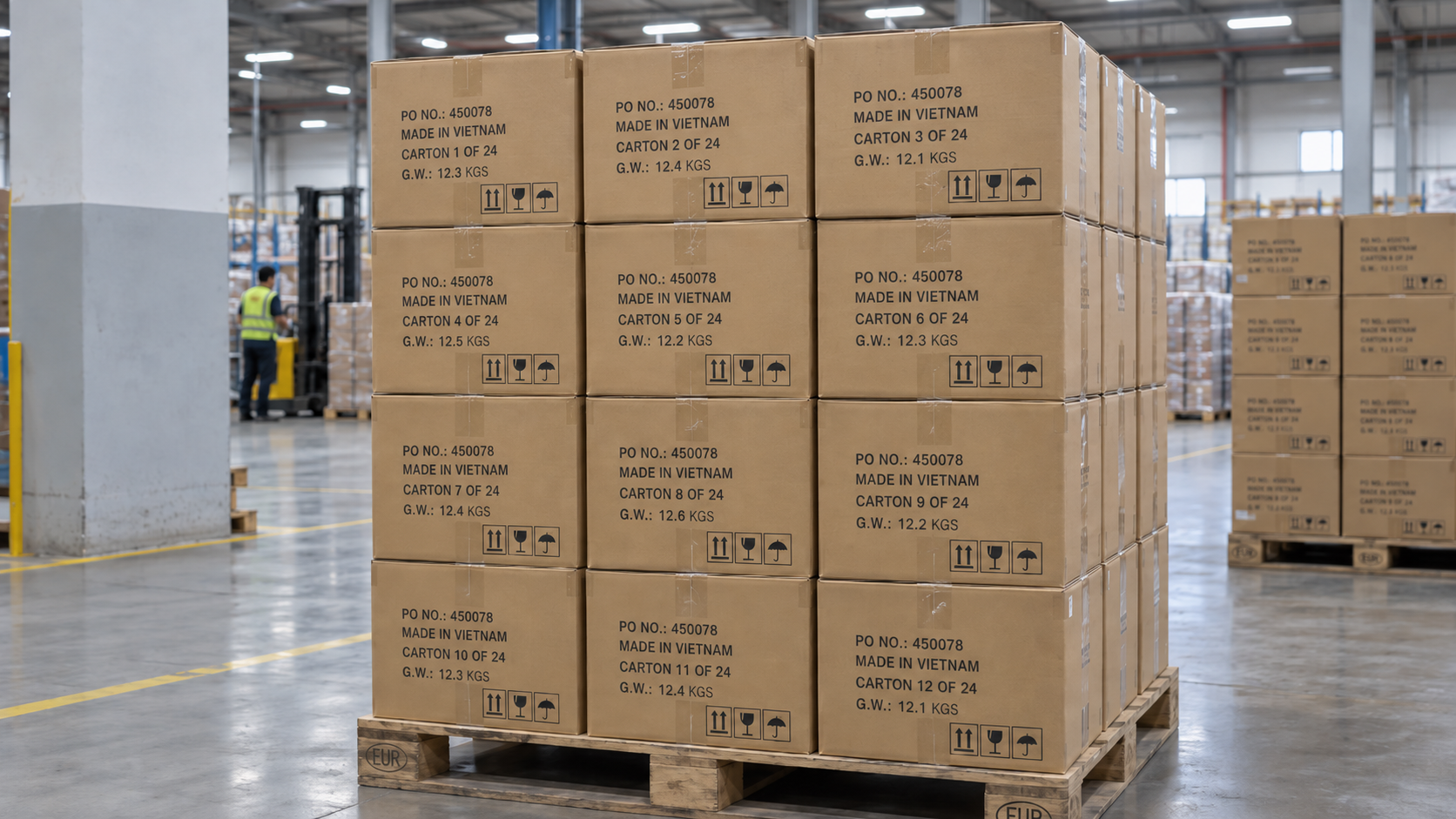
The export carton is the last thing a buyer specifies and often the first thing that causes a problem at the receiving warehouse. Carton marking requirements come from three sources: customs regulations (country of origin on the container), buyer purchase order terms, and the receiving warehouse's operational requirements.
A standard export carton for US-bound garment shipments carries shipping marks on the exterior that typically include the buyer's company name or code, purchase order number, style number, color, size or size ratio, quantity per carton, carton number (sequential within the shipment), country of origin ("Made in Vietnam"), and gross and net weight with outer dimensions. The specific format, placement, and whether marks are stenciled or printed on adhesive labels depends on the buyer's requirements. Consistency matters more than format: the carton marks, the packing list, and the commercial invoice must all agree on every detail.
For shipments entering through a US port, CBP requires country of origin marking on the outermost container. If the garment itself is properly marked (sewn-in "Made in Vietnam" label), the carton marking reinforces the product marking. If a garment were excepted from individual marking, the carton would carry the legal obligation.
Ratio packing vs. solid packing
How garments are arranged within cartons is a buyer specification. The two primary methods are solid packing and ratio packing, and the choice affects warehouse receiving, inventory management, and distribution efficiency.
Solid packing places garments of a single size and single color in each carton. A carton contains, for example, 24 medium navy shirts and nothing else. Solid packing simplifies warehouse receiving and inventory allocation, because each carton maps to a single SKU. It is standard for programs with high volume per size and color.
Ratio packing (also called assorted packing) places garments of a single color in multiple sizes within each carton, following a size ratio specified by the buyer. A carton might contain a ratio of S:M:L:XL at 2:3:3:2 for a total of 10 units per carton, all in the same color. Ratio packing is common for wholesale and retail distribution, where each carton ships directly to a store location and should contain a representative size spread.
The buyer must specify the packing method, units per carton, and size ratio (if applicable) before the factory reaches the packing stage. Changing the packing method after garments are folded and bagged means repacking the entire shipment, which adds cost and delays the ship date. The packing instruction belongs in the purchase order, confirmed alongside the quality control and inspection plan before production begins.
What the buyer needs to specify before label production
Label compliance is a production planning exercise. Every element of the sewn-in label, the hangtag, and the carton marking depends on information the buyer must provide or confirm before the factory can proceed. Waiting until final inspection to discover that the care label is missing a bleaching warning or that the hangtag barcode is assigned to the wrong size creates delays that ripple backward through the ship date.
Fiber content confirmation
Confirmed fiber composition of the fabric as delivered. Percentages must reflect the actual blend of the production fabric, verified against mill test reports.
Care instructions with testing basis
Care instructions supported by wash and wear testing on the production fabric and construction. The importer must hold a reasonable basis for the instructions before the garment is offered for sale.
RN or business name
The US importer's or brand's FTC Registered Identification Number, or the full legal business name to appear on the label. This identifies the party responsible under US law.
GS1 UPC assignments
A unique GTIN assigned for each SKU: every combination of style, color, and size. Barcode artwork for hangtags and polybag labels, formatted to the retailer's compliance guide specifications.
Packing instructions
Solid or ratio packing, units per carton, size ratio (if applicable), polybag requirements, folding method, and whether garments ship on hangers or flat packed.
Carton mark format
Shipping mark layout including PO number, style, color, size, quantity, carton numbering sequence, weight and dimension placement, and any retailer-specific label or sticker requirements.
For children's programs, add CPSIA tracking label format (production date, location code, batch number) and confirm that the information will appear on both the garment label and the polybag or carton packaging.
All of this information feeds into label artwork that must be approved before the factory orders labels. Pham Fashion House coordinates label approval as part of the pre-production process, confirming that every element of the sewn-in label, hangtag, and carton marking is accurate and complete before labels are printed and before fabric reaches the cutting table. Discovering a label error during final inspection requires relabeling the entire shipment, which costs time, money, and often the ship date.
Vietnam apparel production partner
Preparing a US-bound shipment from Vietnam production?
Pham Fashion House coordinates Vietnam apparel production for established brands and institutional buyers, including label compliance, packaging, and carton marking as part of the pre-production planning process. Programs typically start at 3,000+ units per style.
Discuss Your Program