Protecting Intellectual Property in Apparel Manufacturing: A Practical Guide for Brands Working with Overseas Factories
The most common way a design leaks in overseas production is not theft. It is a factory quietly reusing your pattern for another client, or an intermediary you never met receiving your full tech pack. The contract most brands rely on to prevent this, a standard NDA, is built for the wrong problem, and understanding why is the first step in actually protecting a design.
For brands sharing tech packs, graded patterns, and construction detail with manufacturers across the world, design protection is a structural question rather than a legal afterthought. It is decided by how the relationship is built, how information is segmented, which agreement sits underneath it, and how many hands the specification passes through before it reaches a sewing floor. The same structure decides something buyers ask about more often than design theft: whether the fabric that reaches the cutting table is the fabric that was approved.
This guide covers where design IP actually leaks in overseas apparel production, how fabric and trim substitution happens mid-production and which approval gates stop it, who owns the pattern and tooling once development has been paid for, why the trading-company layer changes the risk, and how to structure a program so the intermediary protects your specification rather than exposing it.

How do designs actually leak in overseas manufacturing?
Brands tend to imagine IP loss as a dramatic act of theft. In practice it is quieter and more structural, and it happens through four mechanisms that have little to do with anyone breaking into anything.
Pattern reuse
A factory that has cut and graded your pattern holds the single most valuable asset in the garment. Without a clause specifically prohibiting it, the factory can use that pattern for another buyer, and in many jurisdictions this is not a clear breach of a simple confidentiality agreement.
Full-package handoff to unknown parties
When a complete tech pack passes through an intermediary, every party in the chain receives the whole specification. A design shared to get a single garment made can end up in the hands of sub-suppliers the brand never selected and never met.
Circumvention
A factory or agent that has seen the design, the buyer, and the margin can attempt to reach the end customer directly, cutting out the party that brought the program. This is a business risk as much as an IP one, and it is common enough to have its own contractual remedy.
Overproduction and the third shift
A factory runs the approved design beyond the ordered quantity and sells the surplus through other channels. The goods are genuine, made on the same line to the same spec, which makes this harder to detect than a copy.
The pattern is the asset
Reference photos and sketches carry little that a competent factory could not reverse-engineer anyway. The graded pattern, the construction sequence, and the bill of materials are what turn an idea into a manufacturable product. Those are the documents worth protecting, and they are exactly the ones a brand has to share to get anything made.
Why a standard NDA is the wrong instrument
Most brands reach for a non-disclosure agreement, because that is the document they know. An NDA is built for a Western legal setting where the risk being managed is public disclosure, someone leaking a secret to the market. In overseas manufacturing, public disclosure is rarely the actual risk. The risk is a factory using the design internally, for another client or for its own line, which a confidentiality clause does not clearly prohibit.
The instrument built for this situation is an NNN agreement: non-disclosure, non-use, and non-circumvention. The non-use clause prohibits the manufacturer from using your specification to benefit anyone other than you, which is the gap a plain NDA leaves open. The non-circumvention clause prevents the manufacturer or agent from going around you to reach your customers directly. Critically, an NNN agreement is drafted to be enforceable in the manufacturer's own jurisdiction rather than in a Western court that has no practical reach over a factory abroad.
A confidentiality agreement asks a factory not to tell anyone. The clause that matters asks a factory not to use your design at all. Those are different promises.
What fabric and trim substitution actually looks like
Substitution sits next to design protection because both come down to a single question: whether the approved specification survives contact with a production floor. A substituted fabric is a materials failure rather than a stolen design, though the commercial damage lands in the same place, since the garment that arrives is not the garment the brand sold.
Substitution is rarely announced, and it is usually nominally compliant. The swap still satisfies the line written in the tech pack while changing how the garment behaves after it reaches a customer.
One spec line describes several different fabrics
"180 gsm cotton jersey" fits ring-spun and open-end yarn, combed and carded stock, and a wide range of twist levels and finishes. All of them satisfy the written line. They pill differently, take dye differently, and hold shape differently after five washes. A tech pack that names fiber and weight without naming yarn construction, finish, and mill quality leaves the choice with whoever buys the fabric.
Why substitution happens
Mill minimums and short lots
The approved quality carries a mill minimum above what the order requires, or the lot runs short once cutting losses are counted. The gap gets filled with whatever is available in the same nominal weight, often from a different mill.
Price movement after the quote
Yarn and greige prices move between quotation and fabric booking. A factory holding a fixed price either absorbs the difference or finds a cheaper equivalent, which is one reason a quote should state which fabric it was built on. Our guide to apparel costing and FOB pricing covers what a quote does and does not lock.
Dye and finish failures in bulk
A quality that passed lab dip can fail shade or hand once it is dyed and finished at bulk scale. Rebooking costs weeks against a fixed ship date, so the pressure runs toward shipping what already exists.
Discontinued qualities on reorder
The first run is correct and the third is not, because the mill dropped the quality in between. Reorders carry higher substitution risk than initial production, which is why repeat production programs need materials locked at the program level rather than per order.
Where substitution hides
Fabric gets the attention. Trims carry more of the risk, because they are cheaper to change, easier to justify, and far harder to see in a finished garment.
Interlinings and fusibles
A lower-grade fusible passes visual inspection and bubbles along collars, cuffs, and front edges after washing or dry cleaning. The failure appears weeks after delivery, which puts it beyond most inspection regimes.
Sewing thread
Thread fiber and ticket number govern seam strength and puckering. A substituted thread changes seam performance and stitch appearance while costing a fraction of the fabric it holds together.
Hardware and elastic
An unbranded slider substituted for a named zipper fails under cycle testing rather than in the carton. Elastic below the approved specification loses recovery after repeated laundering, which shows up first in waistbands and cuffs.
Labels and content claims
A substituted fiber blend makes the care and content label inaccurate, and the regulatory exposure for a mislabeled garment sits with the brand named on it rather than with the factory that made it.
A substituted fabric passes visual inspection, ships on time, and fails in the customer's washing machine. The control has to sit at fabric approval, because final inspection is already too late.
The approval gates that prevent substitution
A record of not substituting fabrics without approval is a procedural claim, which makes it verifiable. Ask any prospective manufacturer or sourcing partner which of the following gates exist, who signs each one, and what happens when a gate fails.
Lab dip and strike-off approval
Shade submitted against a physical standard under specified lighting, and prints approved as strike-offs on the actual base cloth rather than on paper. Approval is recorded by submission number and date.
Bulk fabric approval before cutting
Delivered bulk checked against the approved standard for weight, width, shade, hand, and construction before the marker is laid. This is the gate that prevents substitution. After cutting, the conversation is about remedy.
Test reports and independent verification
Composition, weight, shrinkage, colorfastness, pilling, and strength testing, with clarity on who tests, against which standard, and whether the buyer receives the report. Programs carrying a regulatory or performance claim warrant independent laboratory testing rather than a mill self-declaration.
Inspection at goods-in
Received rolls inspected for defects, shade banding across the lot, and width consistency, with a documented accept or reject decision. Our guide to quality control and inspection in Vietnam covers how this connects to in-line and final inspection.
A trim card with no default equivalents
Every trim approved on a physical card, with brand and article number named where performance depends on it, and written language stating that equivalents require approval rather than being permitted by default.
A written change request procedure
No substitution proceeds on a phone call. A request should name the original and the proposed alternative, give the reason, include physical swatches of both, attach comparative test data, and state any cost or lead-time effect, with the buyer's written approval required before fabric is booked.
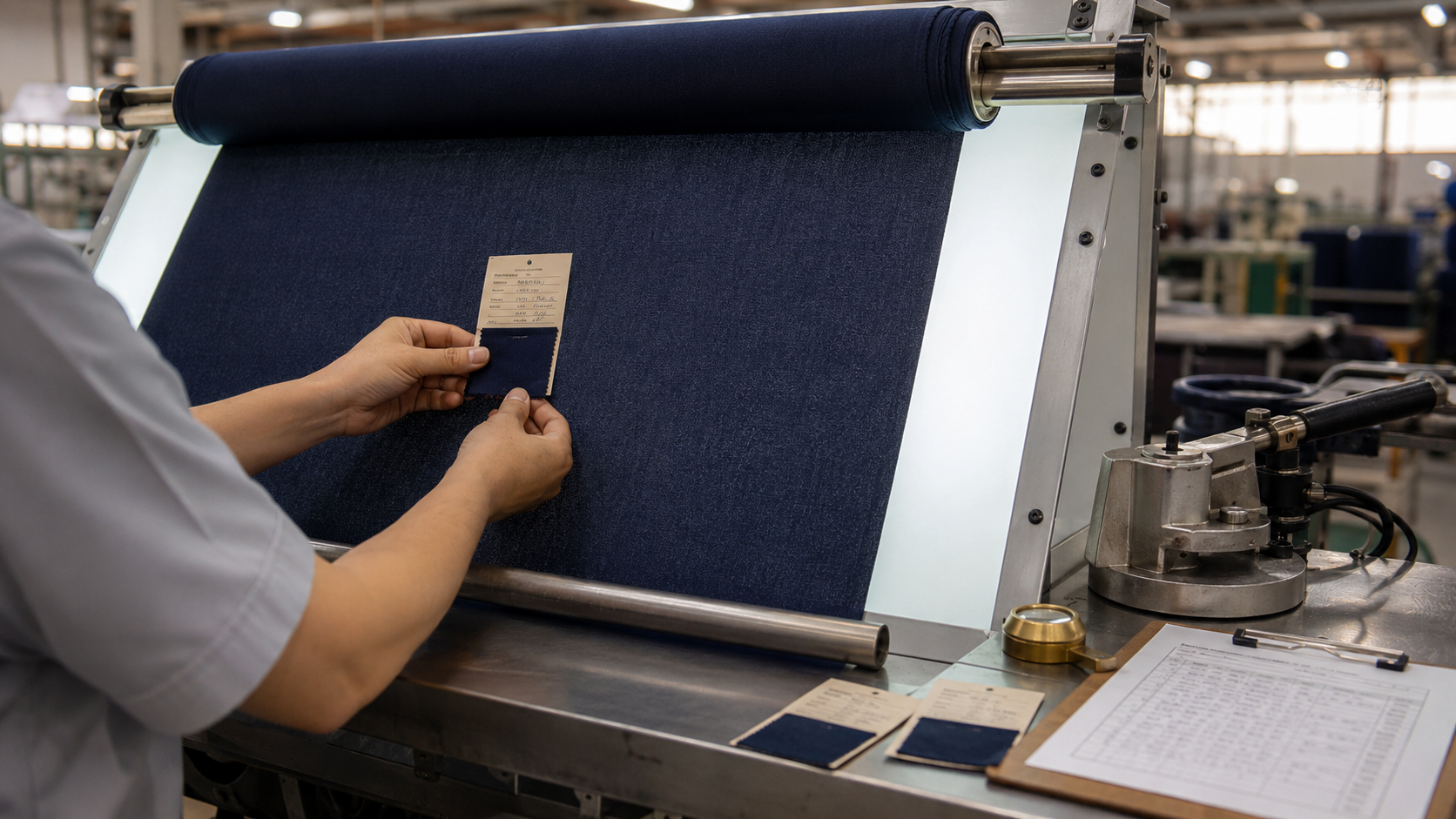
Physical standards outrank written ones
A shade named by color reference and a shade approved as a physical lab dip are two different controls. Digital references travel well and reproduce badly. Where color, hand feel, or surface finish carry the product, the governing standard should be a piece of cloth held by both parties, dated and signed.
Sealed samples: the physical standard for bulk production
A tech pack describes intent. A sealed sample is the physical standard that governs bulk production, and the distinction decides most disputes. Written specifications leave room for interpretation. A sealed sample, signed and dated with one copy retained at the factory and one held by the buyer or the buyer's agent, removes most of that room.
Our production network runs two sampling stages before anything is sealed. A quality sample validates construction, seam types, and assembly sequence before final materials are committed, which keeps a fabric commitment from being made against an unproven construction. A production sample follows in the final approved fabric and trims, and that sample becomes the bulk production reference. Our guide to the Vietnam sample development process covers both stages in detail.
What sealing does
The sealed sample is referenced in the purchase order by number and date, which makes it contractual rather than advisory. The factory cannot deviate from it without written approval, and a deviation is measurable against a physical object instead of arguable against a paragraph.
Why it matters on reorders
Counter samples for repeat runs should be judged against the original seal rather than against the previous shipment. Comparing each run to the last one allows small acceptable variations to compound until the fourth delivery no longer resembles the first.
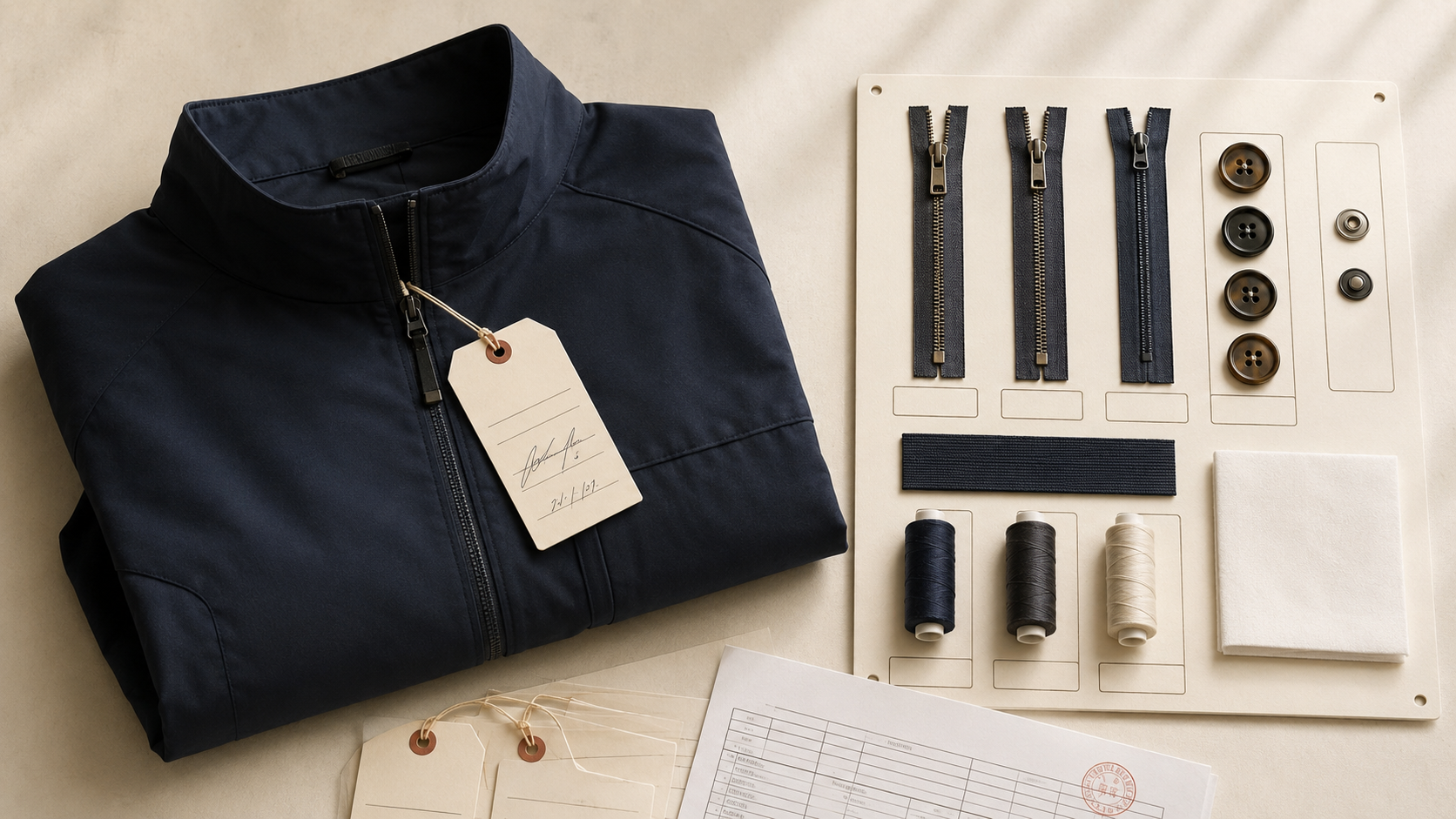
Shipment samples pulled from sealed cartons before departure, and retained until the season closes, complete the record. A complaint arriving three months after delivery can then be tested against what actually shipped rather than against memory.
Who owns the pattern, the marker, and the tooling?
Paying for development does not automatically transfer ownership. In most manufacturing jurisdictions the party that created a pattern holds rights in it unless an agreement assigns them, so a brand that funded grading can find the factory holding the asset. The assignment has to be written, and it has to name the items individually, because a general intellectual property clause rarely reaches production tooling.
The graded pattern and its digital files
Ownership plus a delivery obligation in a named file format. A pattern that exists only inside one factory's system is not portable, whatever the contract says about who owns it.
Fit blocks and the size standard
A block developed to a brand's fit is what makes the next style faster, and it is the asset most often reused for another client. Name the block separately from the styles built on it.
Markers and consumption data
The marker and its yield figure carry the cost basis of the garment. Whoever holds them holds the ability to requote the style elsewhere.
Embroidery, print, and hardware tooling
Digitized embroidery files, screens, and dies for custom hardware are assets a buyer usually funds and a supplier usually keeps. List each one, along with who holds it and what happens to it later.
Close the set with an end-of-program clause covering patterns, files, sealed samples, surplus branded trims, and unused labels. Return or documented destruction of branded labels is the term that closes the overproduction route described earlier, since surplus goods need labels before anyone can sell them.
How do I protect my design when working through a trading company?
A trading company or sourcing intermediary sits between the brand and the factory, which changes the picture in two directions at once. One is a genuine risk to manage. The other is an underused protection.
The risk is that an intermediary becomes one more party holding your full specification, and in a poorly structured relationship, the one most able to circumvent you, since it holds both your design and your customer relationship. That is the anxiety behind the question, and it is legitimate.
The protection, in a well-structured relationship, is that the intermediary becomes a firewall. A principal-model sourcing partner contracts with the factory in its own name, holds the manufacturing relationship, and stands between the brand's design and the production floor. The brand's contract is with one accountable party rather than with a factory it cannot easily audit or pursue. Structured correctly, the intermediary carries the non-use and non-circumvention obligations down to the factory, controls which sub-suppliers ever see the specification, and has its own commercial interest in preventing circumvention, because circumvention destroys its business too.

Where accountability actually sits
Three questions separate an accountable intermediary from a forwarding service, and all three are about materials rather than contracts. Who signs the fabric approval. Who holds the sealed sample. Who carries the loss when bulk deviates from it.
In a commission arrangement, the agent signs nothing and carries nothing. Approval sits between the brand and a factory the brand never contracted with, so a substitution dispute becomes the brand's problem to pursue in a foreign jurisdiction. An agent earning a percentage of shipped value also has no financial reason to reject a delivered roll of fabric, because rejection delays the shipment the commission depends on.
In a principal model, the intermediary buys from the factory and sells to the brand, which puts its own money behind the specification. A substitution it accepts becomes a claim against it. That exposure is what accountability means in practice, and it holds even on the weeks when nobody is watching.
The badly structured version
An agent forwards your full tech pack to whichever factory quotes lowest, takes a commission on shipped value, and disappears from accountability. Every party sees everything, no one carries an enforceable obligation, approvals happen informally, and the agent is positioned to circumvent you.
The well-structured version
A principal-model partner holds the factory contract in its own name, carries binding non-use and non-circumvention obligations, signs the materials approvals, holds a copy of the sealed sample, segments what the factory sees, and answers to you as a single counterparty with money at risk.

What actually protects a design: layering legal and operational controls
No single measure protects a design. What works is a combination of a properly drafted agreement, operational discipline in how information is shared, and local registration of the rights that matter most. Any one of these alone leaves a gap the others close.
An NNN agreement, before anything is shared
Non-disclosure, non-use, and non-circumvention, drafted for enforceability in the manufacturer's jurisdiction, signed before a full tech pack changes hands. This is the first document sent, not the last.
Specification segmentation
Limit what any single party sees. A factory needs construction and measurements to build the garment. It rarely needs the brand's full supplier list, pricing, or complete product roadmap. Share what production requires, not everything you hold.
Local design and trademark registration
Register your trademark in the country of manufacture even if you do not sell there, since an unregistered mark can be claimed locally and turned against you. Industrial design registration is available in major manufacturing jurisdictions and gives administrative and civil enforcement routes that an unregistered design does not.
Controlled files and marked documents
Keep master files in a repository you control rather than emailing editable originals into a chain. Marked and dated tech packs establish provenance and make it harder for a shared document to circulate as an unattributed original.
Registration matters more than brands expect
In most manufacturing countries, trademark rights go to whoever registers first, not to whoever used the mark first. A brand that does not register locally can find its own trademark registered by someone else and used to block its goods. Registration in the country of production is a defensive move regardless of where the brand sells.
How do you enforce design rights if something goes wrong?
Enforcement is far easier to describe in a contract than to pursue across a border, which is exactly why the structural measures above matter more than the remedy. That said, buyers should understand what recourse exists, because an agreement with no realistic enforcement path behind it offers less protection than the wording suggests.
An NNN agreement enforceable in the manufacturer's jurisdiction, backed by locally registered design and trademark rights, gives a right holder administrative, civil, and in some cases customs routes within that country. An agreement governed only by the buyer's home-country law, against a factory with no assets in that country, often gives a remedy that cannot practically be collected. The distinction between a contract that reads well and a contract that can be enforced where the factory actually operates is the whole game.
The structure is the same for buyers outside the United States. An Australian, British, or European brand contracting under its own domestic law has no more practical reach into a Vietnamese factory than a US brand does. Where the buyer sits changes the import and duty picture considerably; it changes very little about enforcement. What changes enforcement is whether the agreement was drafted for the jurisdiction where the goods are made, and whether a party holding assets in that jurisdiction is answerable under it.
None of this is legal advice, and the specifics vary by country and by the nature of the design. A brand with meaningful IP exposure should work with counsel familiar with the manufacturing jurisdiction before sharing specifications. What a sourcing partner contributes is the structure around that legal foundation: who holds the factory relationship, how the specification is segmented, and how many parties ever see the whole design.
What buyers should have in place before sharing a tech pack
Design protection is built before the first specification is sent, not recovered after a leak. Buyers preparing to move a program into overseas production benefit from settling the following in advance.
The right agreement, signed first
An NNN agreement drafted for the manufacturing jurisdiction, in place before a full tech pack is shared with any party.
A single accountable counterparty
Clarity on who holds the factory relationship and who carries the non-use and non-circumvention obligations, rather than a diffuse chain in which no one is answerable.
A segmentation plan
A decision about what each party in the chain needs to see, so the full specification is not distributed by default.
Registration where it counts
Trademark and, where warranted, industrial design registration in the country of production, initiated early because registration takes time.
Physical materials standards
Approved lab dips, a bulk fabric standard, and a trim card naming brands and article numbers, with written terms requiring approval before any equivalent is used.
Ownership named line by line
Written assignment of the graded pattern, digital pattern files, fit blocks, markers, embroidery and print files, and any tooling the buyer funds, plus what happens to all of it when the program ends.
Getting the documentation itself right is upstream of all of this. Our guide to production-ready tech packs covers how a complete specification is built, and our guide to choosing an apparel manufacturing partner in Vietnam covers the relationship structure that sits around it.

How Pham Fashion House handles design protection
Pham Fashion House operates on a principal model. We hold the manufacturing relationship in our own name and stand as a single accountable counterparty between a brand's design and the production floor, rather than forwarding a tech pack to whichever factory quotes lowest and stepping away.
In practice that means the brand contracts with one party, the factory relationship and its obligations sit with us, and we control which parties in the production chain see a full specification against which see only what production requires. Our New York team manages the brand relationship while coordinating Vietnam production, which keeps the design conversation and the factory conversation deliberately separate.
The same structure governs materials. Because we contract with the factory in our own name, a substituted fabric is a loss against us before it is a problem for the brand, which is why the approvals sit with us in writing rather than in conversation. Bulk fabric is checked against the approved standard before cutting, received goods are inspected and documented roll by roll through the factory's fabric inspection system, and testing runs through an in-house textile and garment laboratory on site rather than through a report forwarded from a mill. Sealed production samples are held in New York and in Vietnam, and reorders are measured against the original seal.
We are not a law firm and do not provide legal representation, and brands with significant IP exposure should engage counsel familiar with the manufacturing jurisdiction. What we provide is the structural side of protection: an accountable single counterparty, controlled information flow, and a production relationship built so the intermediary is a firewall rather than an additional point of exposure.
Vietnam apparel production partner
Concerned about protecting your designs in production?
Pham Fashion House coordinates Vietnam apparel production for established brands and institutional buyers on a principal model, with a single accountable relationship between your design and the factory floor. Programs typically start at 3,000+ units per style.
Discuss Your Program