What It Actually Costs to Make a Jacket
A jacket on a rack has one number on it. The quote a factory sends you has another. Between those two numbers sits a cost sheet that most brands receive, glance at, and accept without ever checking whether the arithmetic holds.
The quote arrives as a single FOB figure per unit. Sometimes it arrives with four lines under it. Occasionally it arrives with twenty. The number of lines tells you almost nothing about whether the price is fair, because a quote with twenty lines can still hide the two figures that would let you check it.
This is a guide to reading a cost breakdown you did not build. What the lines mean, which ones move when your spec moves, which ones can be inflated without anyone stating anything false, and what to ask for so the next quote is verifiable. For the terminology itself, including what FOB covers and where the Incoterm hands off, see our guide to apparel costing and FOB pricing. This piece assumes you already have the vocabulary and want to audit the numbers.
A jacket quote is four numbers wearing a costume
Whatever format your supplier uses, every garment cost resolves into four things: materials, labor, overhead, and margin. Everything else is presentation.
Materials
Shell fabric, lining, interlining, insulation, and every trim on the garment. On outerwear this is usually the largest single block, and on a membrane shell it frequently exceeds half the FOB price.
Labor
Cutting, sewing, finishing, and packing, expressed as time rather than money. A jacket does not cost a certain amount to sew. It takes a certain number of minutes, and those minutes have a rate.
Overhead
Factory operating cost allocated across production: building, machinery, supervision, testing, quality inspection, and the sampling that preceded the order.
Margin
What the supplier keeps. In an honest quote this is a stated percentage. In a vague quote it is distributed quietly across the other three blocks.
The useful question is not how many lines a quote has. It is whether each block can be reconstructed from figures the supplier has given you. If you cannot rebuild a block, that block is unverifiable, and unverifiable blocks are where price drifts.
Fabric: check the consumption before you check the price
Most buyers who question a fabric cost question the price per meter. That is the wrong end of the calculation. Fabric cost is a product of three figures, and the price per meter is the one the supplier has least control over.
A fabric line should be stated as: consumption per garment, at a named cutting width, multiplied by price per unit, plus a wastage percentage. If a quote gives you a lump sum for fabric and nothing else, you have been handed a conclusion instead of a calculation.
What consumption tells you
Consumption is derived from a marker, which is the cutting layout for the full size range. A supplier who quotes consumption from an actual marker will tell you the width it was made at. A supplier who estimated it will give you a round number and no width. The difference between an estimated 2.4 meters and a marked 2.15 meters, across 5,000 units, is the entire negotiation.
Wastage sits on top of consumption and typically runs somewhere between three and eight percent, depending on the fabric, the panel shapes, and the size curve. Directional fabrics, checks, napped surfaces, and prints that need matching push it higher, because the marker loses efficiency when panels cannot be rotated or nested. A wastage figure with no explanation attached is a number you cannot argue with, which is precisely why it is worth asking about.
Width matters more on outerwear than on almost anything else, because jacket panels are large. A body panel that fits inside a 150 cm width and does not fit inside a 145 cm width changes consumption by a step, not by a percentage. If two suppliers quote different fabric costs on the same shell, compare the widths they cut at before concluding anything about their mills.
Labor is a time figure with a rate attached
Sewing cost should never arrive as a single number. It should arrive as standard allowed minutes multiplied by a minute rate. Separating those two figures is the single most useful thing a buyer can do to a quote, because they behave differently and they are negotiated differently.
Standard allowed minutes describe your garment. They rise when you add operations and fall when you simplify construction. A clean shell jacket sits in a very different range from an insulated, taped-seam technical piece with a stowaway hood, and the gap between them is measurable in minutes rather than in adjectives. The minute rate describes the factory: its wage structure, its efficiency, and its allocation of overhead. It applies to every style you place there.
Where those minutes come from matters. Our production partner in Vietnam builds standard times using GSD Cost Foundation, a predetermined motion time system, which means the minute figure for an operation is derived from a defined method rather than estimated from a similar past style. A quote built that way can be interrogated operation by operation. A quote built from experience and a feeling for the garment cannot.
Ask what a jacket takes in minutes before you ask what it costs in dollars.
The practical benefit shows up when you want to reduce cost without reducing the garment. If you know that a particular pocket construction carries a specific number of minutes, you can decide whether the pocket earns them. If all you have is a total, your only lever is asking for a lower price, which usually returns as a quieter material substitution instead. That risk, and the approval gates that contain it, are covered in our guide to protecting design and specification integrity in manufacturing.
Trims are where a quote goes vague
Trims look small on a cost sheet and behave large in production. A zipper listed as "zipper, metal, YKK equivalent" is not a specification. It is a placeholder that lets the factory buy whatever meets the description on the day, and the day it becomes a problem is the day a buyer returns a jacket because the pull failed.
Every trim line should carry a supplier name and a part number: the zipper chain type and size, the slider and pull reference, the snap system, the elastic width and construction, the drawcord, the mainlabel and carelabel format, and the hangtag. If a trim is nominated by you, the cost sheet should say so, because nominated trims usually carry a different lead time and a different minimum from the factory's standard book.
Trim minimums are also a quiet driver of cost on smaller orders. A zipper supplier has its own minimum per color and per length. If your order sits below it, you are paying for stock you will not use, and that cost lands somewhere in the quote whether or not it is labeled.
Which lines move when your spec moves
Buyers often ask what a change will cost. A more productive question is which lines it touches, because a change that touches two blocks costs far more than a change that touches one.
Touches fabric only
Adding length, widening a panel, changing a colorway inside the same quality, or moving to a heavier weight in the same construction. Consumption or price per meter moves. Minutes do not.
Touches labor only
Adding topstitching, changing a seam finish, adding a bartack, moving from a two-piece to a three-piece hood. Minutes rise. Materials sit still.
Touches both
Adding a pocket, adding a full lining, converting to a two-way zipper, moving from a bonded seam to a taped seam. New material, new operations, and sometimes new machinery.
Touches everything
Changing the shell to a laminate or a membrane. Fabric price, consumption, minutes, sewing method, testing, and often the factory that should be building it.
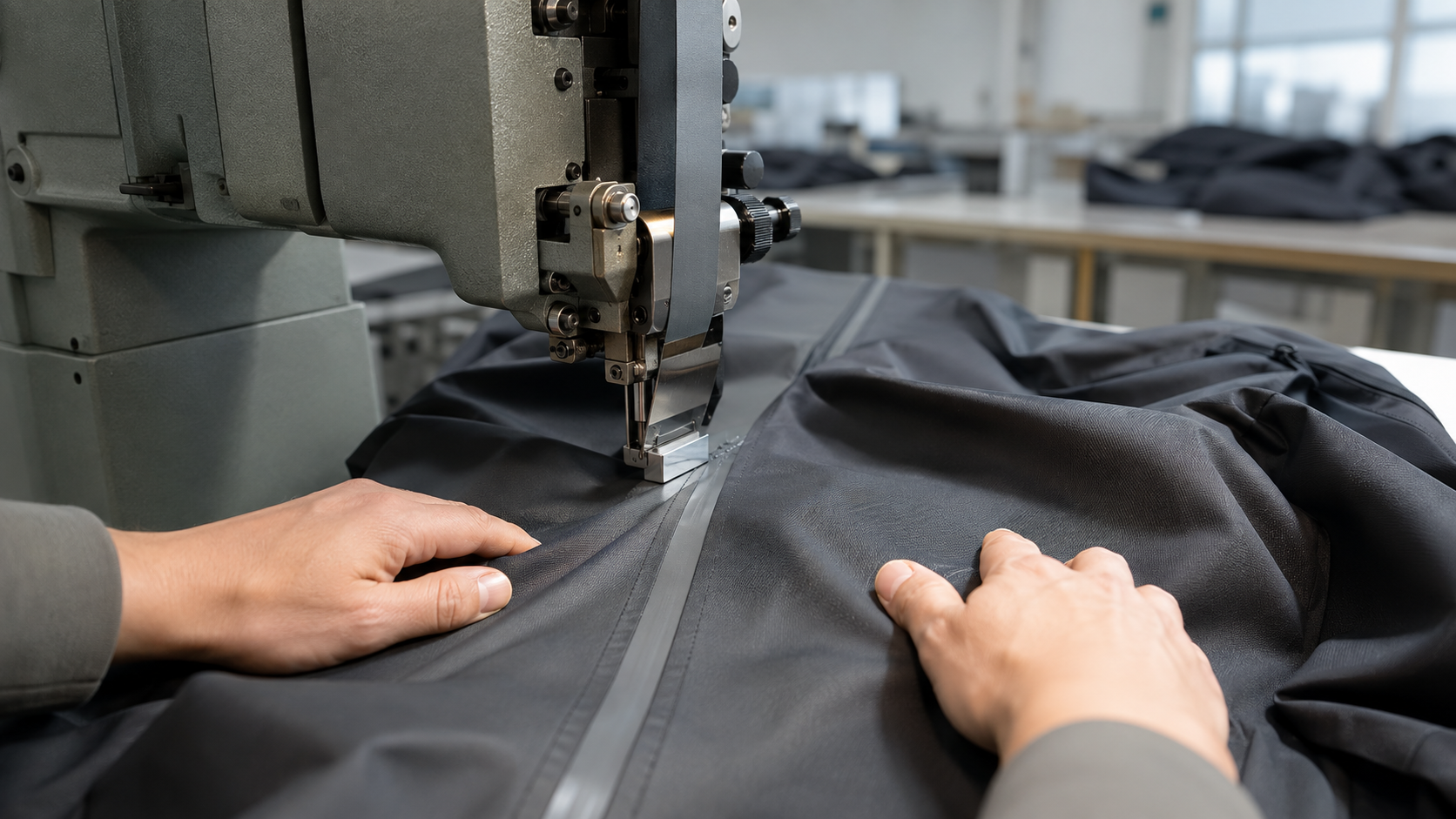
Taped seams deserve particular attention on outerwear, because the tape itself is a minor cost and the sealing operation is not. It adds machine time, a separate process, and an inspection step. Brands moving into waterproof product for the first time are often surprised by the gap between a water-resistant jacket and a genuinely sealed one, which we cover in more depth in our guide to outerwear and waterproof membrane manufacturing.
Where a quote can be padded without anyone lying
Very few suppliers invent numbers. Quotes drift upward through assumptions, and assumptions are defensible in a way that fabrications are not. These are the places to look.
Wastage percentage. Two points of extra wastage on a fabric block that carries half the garment cost is a meaningful sum, and it is nearly impossible to challenge without seeing the marker.
The minute rate rather than the minutes. A supplier can quote entirely accurate standard times against a rate that carries more overhead than the order requires. This is why the two figures need to be separate.
Fabric minimums buried in the price per meter. Mills carry their own minimums, commonly in the range of one to three thousand meters per color. An order below that minimum either pays a surcharge or takes stock fabric. Both are legitimate. Neither should be invisible.
Amortized development. Sampling, testing, pattern work, and marker development are real costs. Spread across a first order they can be significant, and across a repeat order they should largely disappear. If your second order carries the same figure as your first, ask why.
The exchange rate assumption. Quotes are usually valid for a stated period, often thirty to sixty days. A quote with no validity date and no stated currency assumption has left itself room.
What to ask for so the next quote is checkable
You are entitled to ask for the structure of a price without asking a supplier to open its books. The following list does not expose anyone's margin. It simply makes the arithmetic reconstructable.
A costed bill of materials
Every material and trim on its own line, with supplier, reference number, consumption, unit, and unit price.
Consumption at a stated width
For every fabric, with the wastage percentage shown separately rather than folded into consumption.
Minutes and rate, separately
Standard allowed minutes for the style and the minute rate applied, so the two can be discussed independently.
Quantity assumption
The unit count and color split the quote is built on, since both change marker efficiency and material tiers.
Packing method
Polybag specification, folding method, carton dimensions, and whether the quote assumes solid or ratio packing.
Validity and requote triggers
How long the price holds, in which currency, and which changes require a new quote rather than an adjustment.
Almost every item on that list depends on having a finished specification to quote against. A supplier working from reference images and a description will protect itself with assumptions, and those assumptions become the padding. Our guide to production-ready tech packs covers what needs to exist before a quote can be accurate at all.
Why the same jacket costs less at higher volume
Quantity moves price through three mechanisms, and only one of them is negotiation.
Marker efficiency improves as the size curve fills out, because a larger order gives the marker more panels to nest. Material tiers step down as you cross mill and trim minimums, which is a genuine reduction in input cost rather than a discount. Setup amortizes: line changeover, operator training on a new construction, and first-piece approval are fixed costs spread across whatever you order.
This is the structural reason serious production programs are quoted differently from trial runs. Pham Fashion House works at a typical minimum of 3,000 units per style across up to three colorways, with limited flexibility to 1,000 units in a single colorway in select cases. The figure is not a gate for its own sake. It is the point at which the three mechanisms above start working in a buyer's favor rather than against them.
What the quote does not include
An FOB price ends at the port of origin. Everything after that belongs to your landed cost, and a jacket that looks competitive at FOB can lose that position quickly once freight, duty, and inland movement are added. Duty in particular varies by fiber content and construction, which means a spec change can move a tariff classification without moving anything a buyer would notice on the garment. Our Vietnam apparel tariffs guide carries the current rate position and is maintained separately.
Timing belongs in the same category. A price that assumes a comfortable production window and a booking that assumes an urgent one are different prices, and air freight erases a great deal of careful costing. Our guide to apparel production lead times in Vietnam sets out what a realistic window contains.
Pham Fashion House
Have a quote you want read properly?
We manufacture apparel in Vietnam for brands, uniform programs, and institutional buyers, and we build cost breakdowns that a buyer can check line by line. Send us your specification and quantity targets, and we will tell you what your program should cost and why.
Start a Conversation