Linen Program Manufacturing for Hotels and Healthcare Systems
Hotels, health systems, and universities buy bed linens on a written specification, and that specification looks nothing like a retail product description. Thread count barely appears. What appears instead is blend ratio, finished dimensions after laundering, breaking strength, and how many industrial wash cycles the sheet is expected to survive.
Buyers who already run uniform programs for hospitals, hotels, universities, and correctional systems often inherit linens as an adjacent line item, and the two categories are purchased on entirely different logic. A uniform is specified around wear, fit, and appearance in front of a customer. A flat sheet is specified around what happens to it in a tunnel washer, four hundred times.
This guide sets out what a linen specification actually contains, why the familiar consumer numbers mislead in this category, and what a buyer should put in an RFQ so that quotes from different suppliers can be compared honestly. It is written for buyers purchasing goods for a program they own, rather than for those renting linens through a laundry service, since the two arrangements are specified and priced on completely different terms.
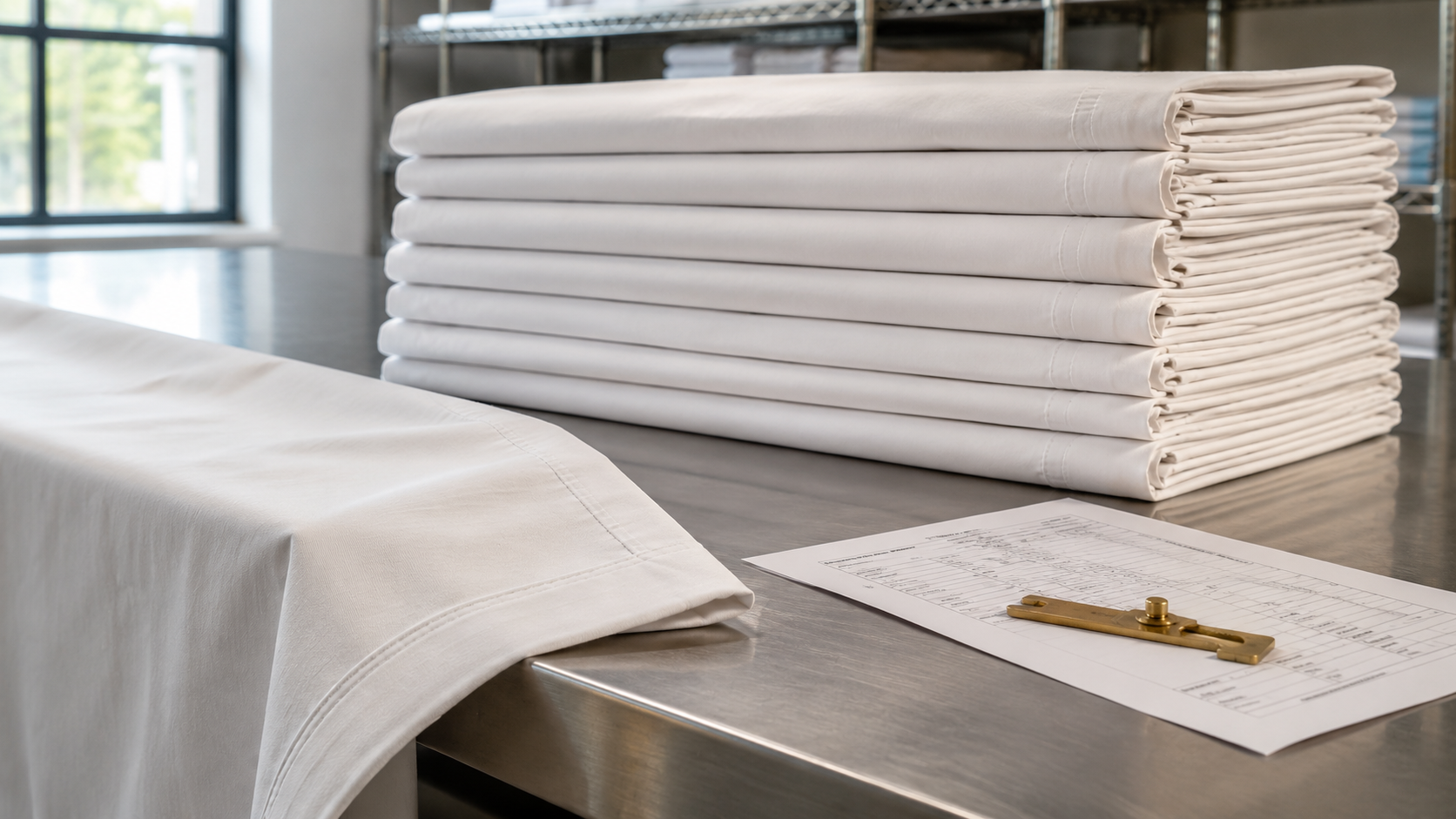
Thread count is the least useful number in the category
Institutional sheeting is described by a T-number: T130, T180, T200, T250. The number counts threads per square inch in the finished fabric, warp plus weft. In this trade the figure is used consistently, which is exactly why it carries less information than buyers expect.
Consumer bedding inflated thread count for two decades by counting plies rather than threads, which is how retail products arrived at figures that no loom produces. Institutional specifications avoided that problem and gained a different one: two T180 sheets can perform very differently depending on the yarn used to reach 180, the blend behind the yarn, and the finish applied afterward. A higher T-number woven from finer, weaker yarn is not a more durable sheet.
What actually predicts durability
Blend ratio, yarn size, weave construction, and finish. A 50/50 polyester-cotton T180 percale and a 60/40 polyester-rich T180 will behave differently after two hundred launderings, and the difference shows up in tensile strength and dimensional stability rather than in the T-number they share.
Polyester-rich blends dominate institutional programs because polyester carries strength, resists shrinkage, and releases wrinkles under mechanical finishing. Cotton content buys comfort, absorbency, and hand. Where a program sits on that scale is a service decision rather than a technical one: patient bedding, dormitory bedding, and premium hospitality bedding tend to sit in different places for reasons that have nothing to do with manufacturing capability.
Dimensions are finished, post-laundering figures
This is the specification line that causes the most disputes, and it is usually a definitional problem rather than a quality problem.
A sheet leaves a cutting table at one size and reaches the customer at another. Cotton-rich sheeting shrinks appreciably on first industrial wash, polyester-rich sheeting far less. If a specification states dimensions without stating whether they are cut, finished, or post-laundering, two suppliers can both meet it and deliver visibly different products.
Institutional specifications name the measurement point and the tolerance, and they usually reference a standard test method for dimensional change so that the shrinkage claim is testable rather than asserted. A buyer moving from retail purchasing to specified purchasing should treat this as the first line to fix, because every downstream complaint about sheets not tucking correctly on a bed traces back to it.
Width, and the seam that should not be there
Sheeting is woven on wide looms specifically so that a full-size sheet can be cut in one piece. A center seam running down a queen or king flat sheet is a rejectable defect in most institutional specifications, because it creates a pressure line against the sleeper and a wear line in the laundry.
Woven width therefore determines which sizes a mill can produce seamlessly, and it is a legitimate question to put to any supplier before a quote is taken seriously. A supplier quoting king sizing from narrow-width sheeting is quoting a seamed product whether the quote says so or not.
Selvage treatment belongs in the same conversation. On a full-width sheet, the loom selvages become the side edges, and the specification should state whether they are used as woven or hemmed. Both approaches are used in the trade, and the choice affects both cost and appearance.
Hems, stitching, and thread
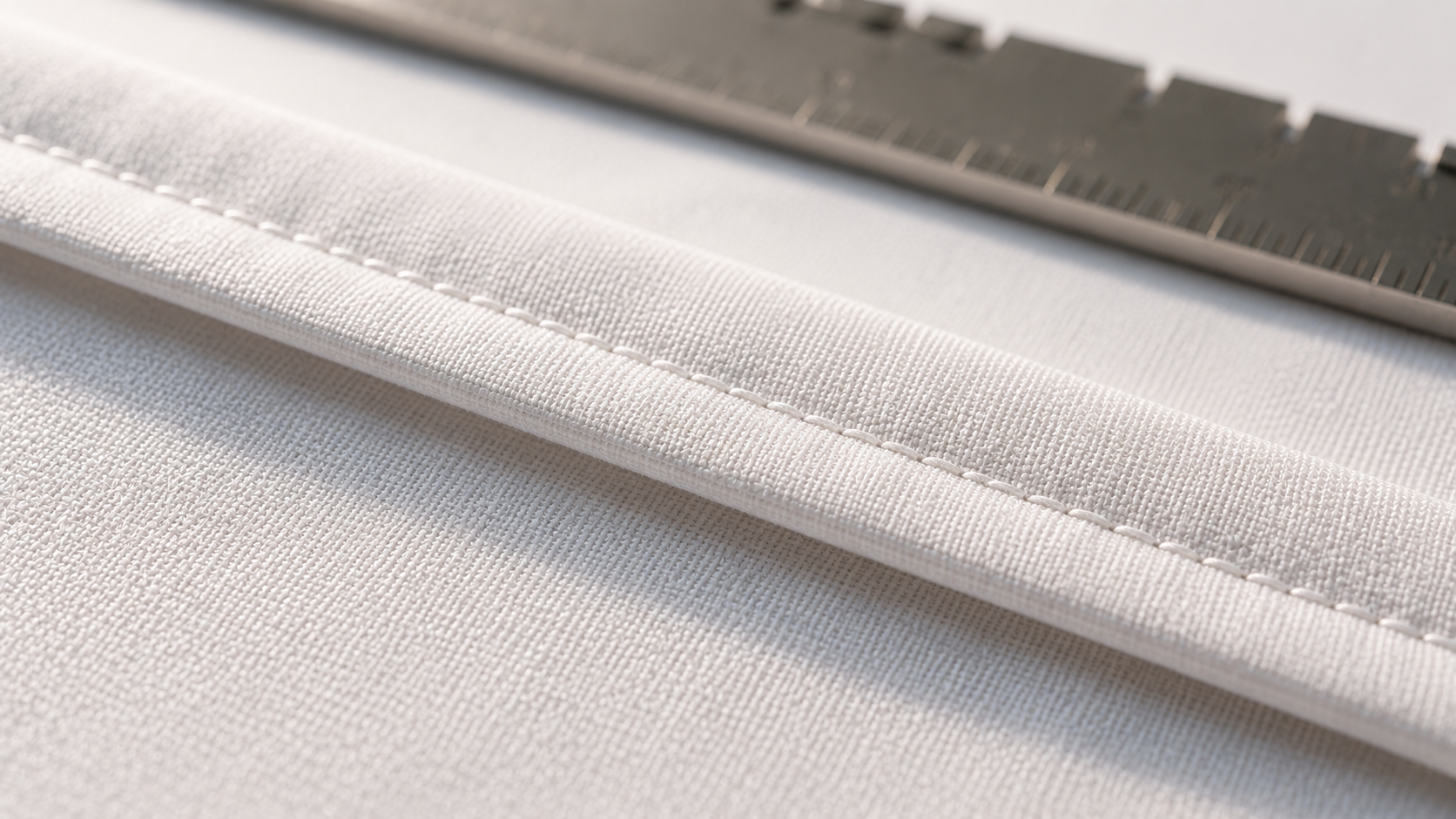
Flat sheets carry an asymmetric hem convention: a deep hem at the head end and a narrow hem at the foot, so that housekeeping and nursing staff can orient a sheet by touch. A specification names both depths, the number of stitches per inch, the stitch type, and the thread.
Thread is worth naming explicitly. Institutional linens are laundered at high temperature with aggressive chemistry, and a seam is only as durable as the thread holding it. Polyester core-spun thread is the usual specification for this reason. Cotton thread in a polyester-rich sheet fails before the fabric does, which produces the confusing situation of a sheet that looks serviceable and comes apart at the hem.
The industrial laundry is the real test condition
Retail bedding is washed gently, occasionally, at moderate temperature. Institutional bedding is washed in a tunnel washer with high-alkalinity chemistry, often with chlorine bleach, and dried at temperatures that a domestic machine does not reach. Then it happens again, on a schedule, for years.
This is why institutional specifications frequently state an expected service life in wash cycles rather than in months, and why colorfastness is tested against laundering and against bleach as separate properties. A colored sheet that holds shade through domestic washing can turn within a handful of industrial cycles.
It is also why finish matters. Wrinkle-resistant and easy-care finishes reduce ironing time in the laundry, which is a labor cost the buyer carries rather than the supplier. Any comparison of two quotes that ignores finish is comparing product cost while ignoring operating cost.
The test methods a linen RFQ should name
Naming test methods converts a specification from a description into something a laboratory can settle. These are the properties an institutional linens RFQ typically covers.
Fabric weight and count
Weight per unit area and the thread count in warp and weft, verified on the finished fabric rather than taken from the mill's nominal specification.
Breaking and tear strength
Tensile strength in both directions, and tear strength, with minimums stated. These are the figures that separate two sheets sharing a T-number.
Dimensional change
Shrinkage after a stated number of launderings at a stated temperature, with a maximum percentage in length and width.
Colorfastness
To laundering, to bleach, to crocking, and to light where the program includes colored goods. Bleach resistance is tested for chlorine and non-chlorine separately.
Seam performance
Seam strength and seam slippage at the hems, plus stitch density verification. A fabric can pass while a seam fails.
Fiber content verification
Quantitative blend analysis confirming the stated ratio, since blend is the property most consequential to durability and the one least visible on inspection.
Where those tests are performed, and whether reports are issued per lot or per program, is a supplier question worth asking early. Our guide to quality control and inspection in Vietnam covers how inspection records and lot documentation should reach a buyer.
Packing, labeling, and the parts of a linen order buyers forget
Linens ship in volume and are consumed by operations teams rather than by individual customers, which changes what packing has to accomplish. A specification should state the pack quantity, the wrap, the carton count, and the carton marking, because a linen room needs to identify size and quality from the outside of a case without opening it.
Size identification on the product itself deserves the same attention. Many institutional programs specify a woven size marker or a color-coded stitch so that staff can sort a queen from a full at speed on a folding table. It is a small line on a specification and a large line on a laundry's labor cost.
Fiber content and care labeling requirements apply to these goods as they do to apparel, and the requirements are set by the destination market rather than by the supplier. Buyers importing into the United States should treat labeling as part of the specification rather than as a shipping detail.
How a linen program fits alongside a uniform program
Pham Fashion House manufactures flat linens through our Vietnam partner network, for the same category of buyer we serve on apparel: hospitality groups, healthcare systems, universities, and institutional purchasing offices already running scaled uniform programs.
The practical argument for consolidating the two is not simply administrative. A hospitality group specifying uniforms and linens through one partner gets one quality standard, one inspection regime, one production calendar, and one set of documentation, and it removes the situation where a uniform program is on schedule and the linens supporting the same property opening are not. Buyers running that kind of combined program should read our guide to scaling uniform programs alongside this one.
Volume expectations are consistent with our apparel programs. Typical minimums sit at 3,000 units per style, with limited flexibility in select cases. Linen programs tend to reach that level comfortably, since a single property refresh usually requires multiple changes of every size in service.
As with apparel, accurate pricing requires a written specification rather than a product reference. If your program does not yet have one, the structure described above is the place to begin, and our guidance on production-ready specifications applies to flat goods with only minor translation.
Pham Fashion House
Running a linen program alongside uniforms?
We manufacture linens and apparel in Vietnam for hospitality groups, healthcare systems, and institutional buyers. Send us your specification, size breakdown, and annual volume, and we will confirm fit and next steps.
Start a Conversation