Corporate Branded Apparel and Merchandise Production: A Guide for Large Programs
Most corporate apparel programs fail quietly. The order arrives on time, the logo is correct, and eighteen months later a storeroom holds four hundred extra smalls, a box of polos in a color the brand no longer uses, and a run of jackets nobody asked for a second time. The money was spent, and the program produced storage.
This guide covers the mechanics behind that outcome and how large organizations avoid it: how order quantities get sized against an actual population, who physically manufactures branded apparel and why that changes what you can specify, which decoration methods survive laundering and which fail, and what to ask a supplier before a program is committed.
It is written for procurement teams, HR and people operations, brand managers, and franchise and multi-location operators running programs at scale rather than ordering for a single event.

This guide covers scaled programs
Pham Fashion House manufactures custom branded apparel for organizations running programs at roughly 3,000 units or more per style, depending on garment type, fabric, colorways, and customization. Smaller one-off orders are usually better served by a promotional distributor, and the economics below assume manufacturing rather than decoration of stock blanks.
Where Corporate Apparel Programs Lose Money
Waste in a branded apparel program is rarely one large mistake. It accumulates through four decisions, each reasonable on its own, and it surfaces as inventory that cannot be issued, returned, or sold.
Ordering flat across sizes
Splitting an order evenly across seven sizes assumes equal demand at every size, which no workforce matches. The overage concentrates at the ends of the range, and those units are the ones that never move.
Buying the whole program at once
A single order covering two years of headcount looks efficient per unit and ignores attrition, hiring, and the sizes that turn out to be wrong. Splitting into an initial run and a planned replenishment costs slightly more per piece and usually less in total.
Decoration tied to a current brand state
An event date, a campaign line, a division name, or a logo mid-refresh turns stock into waste the moment any of it changes. Programs meant to last more than one cycle should carry only the elements that will outlive the cycle.
One garment for an entire population
A single unisex fit across a mixed workforce guarantees a portion of recipients receive something they will not wear. Offering two fits raises unit cost and lowers the share of the order that ends up unused.
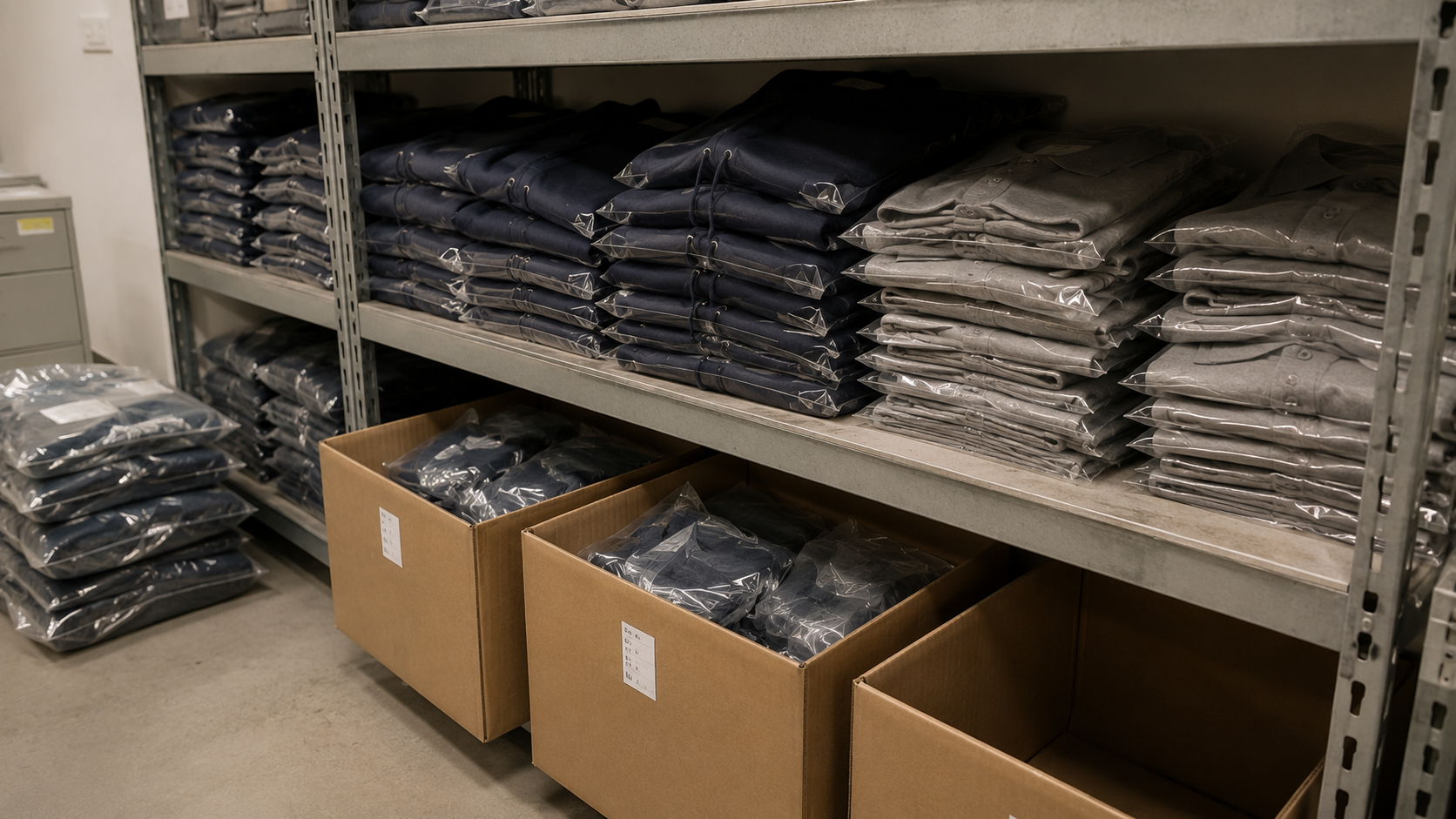
The real cost of overage is not the garments
Unworn stock consumes storage, administration, and eventually disposal, and it prices the next program. A team that ends a cycle with a room full of unissued apparel argues for a smaller budget next time, which is how a poorly sized order becomes a smaller program rather than a better one.
How to Size an Order Against an Actual Population
The size curve is the single most consequential number in a corporate apparel program, and it is usually the least examined. A curve is the percentage of the order allocated to each size, and it should be built from the population receiving the garment rather than from a supplier's default.
Three inputs produce a usable curve. Prior issue data, if any exists, showing what was actually distributed rather than what was ordered. Headcount demographics, since a warehouse population and a corporate office population size differently. And the fit itself, because a relaxed unisex garment and a tailored one shift demand across the range even for the same people.
Where curves go wrong
Copying a curve from a previous program with a different population. Applying one curve across both a men's and women's fit. Underweighting the large end, which is the most common single error and the one that generates immediate complaints rather than quiet overage.
What protects the program
Holding back a percentage of the run as unallocated buffer for new hires and exchanges. Collecting sizes from recipients before ordering rather than estimating. Agreeing fabric and color reservation with the manufacturer so replenishment matches the original.
Reservation is the part that is easiest to skip and hardest to fix later. If the fabric and dye lot behind the first run are not held or documented, the replenishment order is a different garment in the same shape. Our guide to repeat production programs covers how those terms are structured.
Who Actually Manufactures Your Branded Apparel
Almost every organization buying corporate apparel has, at some point, bought from a promotional distributor without knowing what sat behind it. The distinction matters, because it decides what you are able to specify.
In the distributor model, a supplier selects a blank garment from a wholesale catalog, sends it to a decoration shop for print or embroidery, and delivers the result. The distributor controls the logo and the packaging. It does not control the fabric, the fit, the construction, the labels, or whether that blank still exists in twelve months, because none of those belong to it. When a wholesaler discontinues a style or changes its supplier, the program changes with it and nobody in the chain is able to prevent that.
In the manufacturing model, the garment is produced from specified fabric to a specified pattern. Fabric weight, fiber content, yarn construction, fit, seam type, labels, trims, and packaging are all decisions rather than defaults, and the specification belongs to the buyer. That is what makes a program reproducible across years instead of across whatever the catalog carries this season.
What a distributor controls
Decoration method and placement, order quantity, and delivery. Everything about the garment itself is inherited from a wholesale blank, including its future availability.
What a manufacturer controls
Fabric specification and sourcing, pattern and fit, construction, labels and trims, decoration, packaging, quality standards, and the ability to reproduce the same garment on a later order.
If nobody in your supply chain can tell you the fabric weight and yarn construction of your company hoodie, nobody in your supply chain chose it.
Neither model is wrong. A three-hundred-piece order for a conference is a distributor's job and should be. A program that has to look identical across four thousand employees, three regions, and two reorders is a manufacturing problem, and treating it as a purchasing one is what produces the inconsistency organizations later try to correct with a stricter brand guideline.
Decoration Methods and Where Each One Fails
Decoration is where quality complaints originate, and most of them trace back to a method chosen for cost rather than for the garment it sits on. Each method has a use it suits and a condition under which it visibly fails.
Screen printing
Efficient at volume with a limited color count, and the standard for large flat graphics. A heavy ink film on a stretch or lightweight knit cracks along fold lines after repeated laundering, which is the most common branded apparel failure people notice.
Direct-to-garment
Handles photographic detail and gradients with no screen setup, so it suits short runs and complex artwork. Wash durability trails screen printing, it needs a cotton-rich substrate, and dark garments require a white underbase that can leave a visible edge.
Embroidery
The most durable and the most premium, and the right choice for polos, caps, and outerwear. Fine detail and small text fill in and become illegible, cost scales with stitch count rather than with size, and lightweight jersey puckers without correct backing.
Heat transfer and vinyl
Sharp edges, fast turnaround, and effective for names and numbers on event and team apparel. Edges lift with age and washing, and large solid areas trap heat, which recipients notice on anything worn actively.
Applique and woven patches
Durable, dimensional, and well suited to large marks on outerwear and heavyweight fleece. Higher cost per unit and additional production time, so it fits premium tiers rather than broad distribution.
Woven labels and internal branding
Neck labels, hem tabs, and internal prints carry the brand without turning the garment into signage. Frequently the difference between apparel people wear by choice and apparel they wear because it was provided to them.
Decoration has to be graded with the garment
A logo applied at identical dimensions on every size looks correct in the middle of the range and wrong at both ends. It crowds the chest on the smallest sizes and floats on the largest. Placement and scale should be specified per size band, which a manufacturer will do as part of grading and a decoration shop working from a single artwork file will not.
What to Ask Before Committing a Program
Procurement and HR teams evaluating corporate apparel suppliers are usually comparing quotes built on different assumptions. These questions surface the differences that a price comparison hides.
"Do you manufacture, or do you decorate a blank?"
The most useful question in the conversation. It determines whether fabric, fit, and labels are specifiable, and whether the garment can be reproduced in two years.
"What fabric is this, precisely?"
Fiber content, weight in grams per square metre, and yarn construction. A supplier who can only answer with a fabric name is quoting someone else's product.
"What happens on the reorder?"
Whether fabric and color are reserved or documented, what the minimum reorder is, and what happens if the mill discontinues the quality. Ask what governs the second run, and expect a sealed sample as the answer.
"Who holds the approved standard?"
A physical signed and dated sample held by both parties, referenced on the order. Our guide to design protection and sealed samples covers why that matters more than a written specification.
"What testing is done, and do I see the report?"
Shrinkage, colorfastness, and wash durability against the laundering the garment will actually face. Our guide to quality control and inspection covers the stages involved.
"How does it arrive?"
Bulk to one address, pre-sorted by location, or kitted per recipient. This changes cost and lead time substantially and is frequently priced as an afterthought.
Distribution: Where Programs Get Expensive Late
A quote covering manufacture and delivery to a single warehouse is not comparable to one covering distribution to ninety locations, and organizations regularly discover the difference after the order is placed.
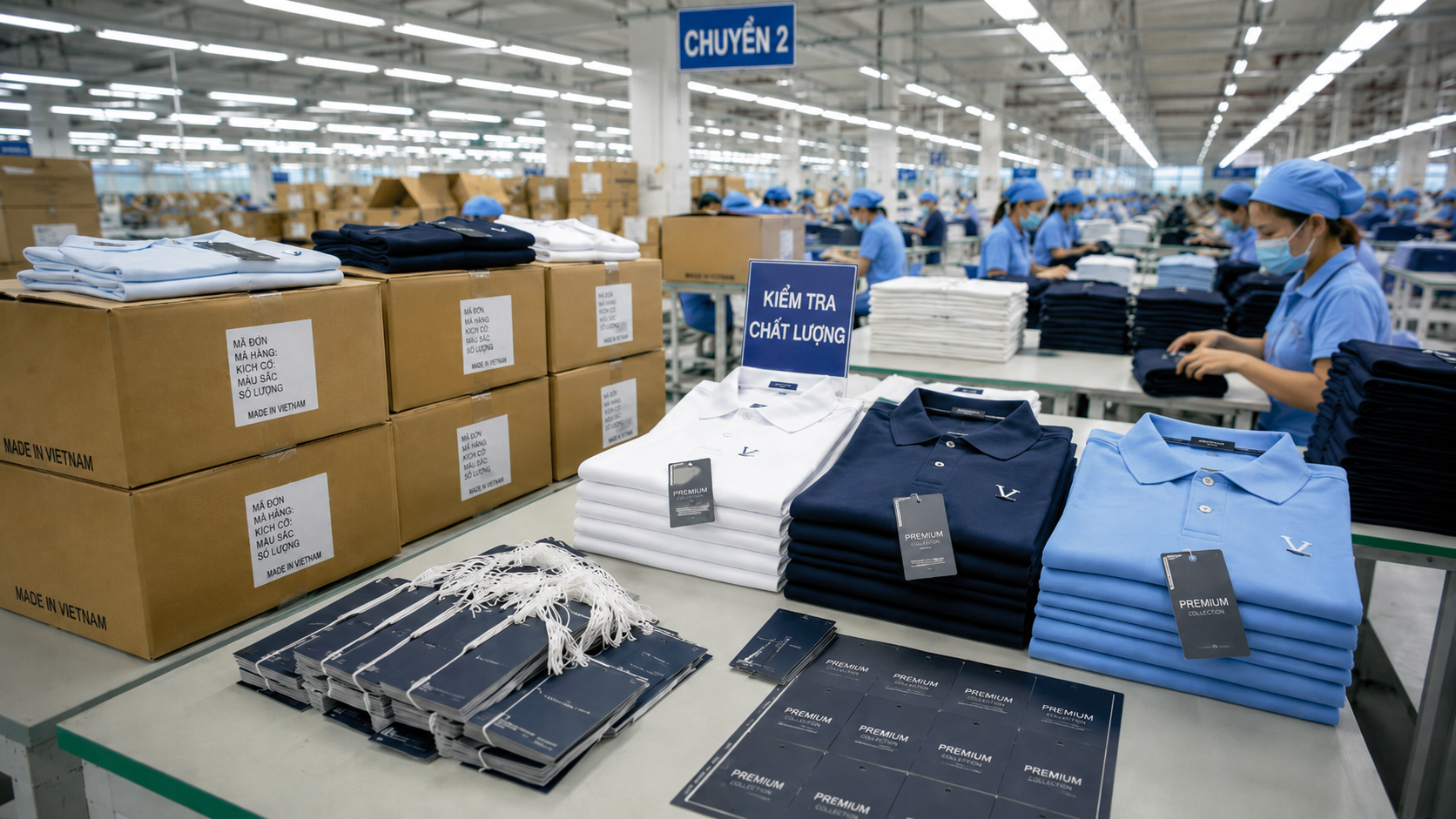
Three models cover most programs. Bulk delivery to a central point, with internal distribution handled by the organization, which is cheapest and moves the labor rather than removing it. Pre-sorted delivery, where cartons are packed by location or department against a supplied allocation and arrive ready to hand out. And individual kitting, where each recipient's items are packed and labeled separately, sometimes shipped direct, which costs the most per unit and eliminates internal handling entirely.
All three are decided at production rather than after it, because carton packing, labeling, and documentation are part of the manufacturing brief. Deciding late means repacking, and repacking is paid for twice.
Franchise Networks and Multi-Location Programs
Programs spanning independently operated locations carry a problem that headquarters-run programs do not. Franchisees, dealer networks, and regional operators buy on their own budgets and timelines, which means the brand standard has to survive being purchased in fragments by people who did not set it.
Two structures work. A central buy held as inventory and drawn down by locations preserves consistency completely and puts working capital and storage on the parent. An approved program with a single manufacturer, where locations order against a fixed specification and a sealed standard, spreads the cost and holds consistency provided nobody is permitted to substitute a local supplier for one season.
What fails is an approved artwork file with no approved garment behind it. Locations buy the logo correctly and the product differently, and within two cycles the network is wearing four versions of the same shirt in three shades of the same color. Consistency lives in the fabric and the sealed sample rather than in the brand guideline.
Order Quantities and Program Fit
Minimum order quantities in custom manufacturing are tied to production economics: fabric mill minimums, dye lots, trim sourcing, cutting efficiency, line setup, labeling, inspection, and freight. Most of those costs are incurred once regardless of whether the run is 500 units or 5,000.
Custom fabric, specified colors, private labels, branded trims, coordinated packaging, and reproducible reorders each require enough volume to justify the setup behind them. Pham Fashion House programs typically start at 3,000 units per style, with limited flexibility in select cases depending on garment type, fabric, and colorway count.
Below that threshold, a promotional distributor working from stock blanks is usually the more sensible route, and it is worth saying plainly rather than discovering it after three weeks of development. Organizations whose volume is growing toward that range are welcome to start the conversation early, since the planning work ahead of a first manufactured run benefits from lead time. Our guide to apparel costing and FOB pricing covers what drives the number on a quote.
Why Vietnam Suits Scaled Corporate Apparel
Corporate apparel programs span categories that rarely sit in one factory: knit tops, fleece, woven shirting, outerwear, and workwear. Vietnam's manufacturing base covers that range with export-grade capability across all of it, which allows a multi-category program to run through one coordinated relationship rather than four disconnected ones.
The relevant capability for this category is less about any single garment and more about consistency infrastructure: fabric inspection at goods-in, in-house testing, documented sealed samples, and quality systems calibrated to buyers who reorder seasonally. Those systems exist in Vietnam's export factories because international retail programs demand them, and a corporate apparel program benefits from the same discipline.
Organizations building an own-brand program may also find our guide to private label apparel manufacturing useful, since the labeling and packaging considerations overlap closely.

Where Corporate Apparel and Uniforms Overlap
Plenty of branded apparel is also operational. A delivery driver's jacket, a service polo, a retail associate shirt, and an event staff layer all represent the company to customers while functioning as workwear, and that dual role raises the durability and consistency requirements above what a marketing-led program would set.
Where a program is primarily operational, our guides to workwear manufacturing in Vietnam and custom uniform manufacturing cover the requirements in more detail. Organizations running programs across multiple sites or properties may want our guide to scaling uniform programs.
How Pham Fashion House Supports Branded Apparel Programs
Pham Fashion House manufactures custom branded apparel in Vietnam for organizations running programs at scale. We are not a promotional distributor and we hold no catalog. Every program is produced from specified fabric to a specified pattern, which is what makes the garment reproducible on the second order and the fifth.
We support the work from product planning and fabric sourcing through sampling, decoration specification, production oversight, inspection, packing, export documentation, and delivery. Sampling runs in two stages, with a quality sample validating construction before final materials are committed and a production sample in the approved fabric becoming the sealed reference for bulk and for every reorder after it.
Because we contract with the factory in our own name, the specification is enforced by the party the client is contracted with rather than passed along a chain. Programs typically start at 3,000 units per style. Buyers should arrive with the population size, the category mix, a target timeline, and any brand standards that constrain color or labeling.

Corporate branded apparel manufacturing
Planning a branded apparel program at scale?
Pham Fashion House manufactures custom corporate apparel and branded merchandise in Vietnam for organizations running programs across employee populations, franchise networks, and multi-location operations. Programs typically start at 3,000+ units per style.
Discuss Your Program