Vietnam's Free Trade Agreements: A Guide for Apparel Buyers
Vietnam takes part in more than 16 free trade agreements, the broadest network of any major apparel production country. For buyers shipping to the EU, UK, Japan, Canada, Australia, the UAE, Israel, South Korea, or Mexico, those agreements can eliminate or sharply reduce import duties on Vietnamese-made garments. Preferential access is not automatic, though. Each agreement has its own rules of origin, and whether a production program qualifies depends on where the fabric comes from, where the yarn was spun, and how much of the manufacturing happened inside the agreement zone.
This guide covers what each of Vietnam's major trade agreements requires for apparel, how the three tiers of origin rules work, and what the network means for buyers planning production across multiple destination markets. For current tariff rates by market, see our Vietnam apparel tariffs guide, which tracks rates as they change.

Why the FTA network matters for apparel buyers
A factory quote tells you what production costs. A trade agreement tells you what the destination country charges when the goods arrive. The gap between the MFN (most favored nation) duty rate and the preferential rate under a free trade agreement can represent 8 to 17 percentage points on the landed cost of a garment, depending on the market and the product category. For a production program running tens of thousands of units, that difference adds up quickly.
Vietnam's trade agreement portfolio covers the European Union, the United Kingdom, Japan, Canada, Australia, New Zealand, Mexico, South Korea, Singapore, the UAE, Israel, China, and the full ASEAN bloc. No other major apparel sourcing country has that breadth. Bangladesh, the world's second-largest garment exporter, has a single bilateral preferential trade agreement (with Bhutan) and is scheduled to graduate from the EU's Everything But Arms program by 2029, which will strip its current duty-free access to Europe unless a successor agreement is in place. Cambodia and Myanmar share the same EBA exposure. Indonesia has bilateral agreements with Japan and Australia but no comprehensive access to the EU or UK through a dedicated FTA.
For buyers sourcing from Vietnam, the agreements are already ratified and operational. The question is whether a given production program meets the rules of origin that each agreement requires.
How rules of origin work for apparel
Every trade agreement includes rules of origin: the criteria a product must meet to qualify for preferential tariff treatment. For apparel, these rules focus on where in the supply chain the qualifying transformation happened. Did you spin the yarn in the region? Weave the fabric there? Or simply cut and sew imported fabric into finished garments?
Vietnam's agreements fall into three tiers of strictness, and understanding which tier applies to the agreement governing your destination market is the single most important factor in determining whether you capture the preferential rate.

Yarn-forward (most restrictive)
Yarn spinning, fabric formation, and garment assembly must all happen within the agreement zone. This is the standard under CPTPP. A short supply list provides exceptions for specific materials that are not commercially available within member countries, and a de minimis rule allows up to 10% by weight of non-originating fibers. Elastomeric yarn must be wholly formed within the CPTPP region regardless of the de minimis threshold.
Fabric-forward (moderate)
Fabric weaving or knitting and garment assembly must happen within the agreement zone or a qualifying cumulation partner. Yarn may be imported from outside the region. This is the standard under EVFTA and UKVFTA. The EVFTA includes an important cumulation provision: fabric produced in South Korea (which has its own FTA with the EU) qualifies as originating, allowing Vietnamese factories to use Korean fabric and still capture the EU preferential rate.
Change in tariff classification (most flexible)
The finished garment must fall under a different tariff heading than the input materials, which for apparel typically means cutting and sewing fabric into a garment satisfies the requirement. Fabric and yarn may be sourced from anywhere within the RCEP region, which includes China. This makes RCEP the easiest origin rule for Vietnamese garment manufacturers to meet, since most Vietnamese factories import Chinese fabric.
The practical consequence of this tiered structure is significant. A Vietnamese factory that imports Chinese fabric can qualify for RCEP preferential rates when shipping to Japan, but cannot qualify for CPTPP preferential rates for the same shipment unless it switches to yarn and fabric sourced within the CPTPP zone. The same factory shipping to the EU would need to use fabric woven in Vietnam, the EU, or South Korea to qualify under EVFTA. The garment is the same; the supply chain behind it determines the duty rate at the destination.
This is also where factory selection becomes a tariff question, not just a production question. A factory with its own knitting or weaving capacity, or one that sources fabric from domestic Vietnamese mills, can qualify for agreements that a pure cut-and-sew operation using imported fabric cannot. Our guide to choosing an apparel manufacturing partner in Vietnam covers how to evaluate factory capabilities beyond price and lead time.
The agreements, by destination
European Union: EVFTA
The EU-Vietnam Free Trade Agreement entered into force in August 2020 and has progressively eliminated tariffs on Vietnamese apparel exports. By 2026, the phase-in schedule for most garment categories has completed, and qualifying goods enter at preferential rates that are a fraction of the EU's standard MFN duties. The EVFTA is a bilateral agreement between Vietnam and all 27 EU member states, covering goods, services, investment, and intellectual property.
The origin requirement is fabric-forward: the fabric must be produced (woven or knitted) in Vietnam or the EU, and the garment must be assembled in Vietnam. The South Korea cumulation provision is a distinctive feature. Because South Korea has its own FTA with the EU, Korean-origin fabric used in Vietnamese garment production qualifies as originating under EVFTA. This matters because South Korea is a significant supplier of technical and performance fabrics to Vietnamese factories.
Not all EVFTA apparel categories require full two-stage transformation. Some items qualify under a "1.5-stage" provision that permits a limited percentage of non-originating fabric (generally 40% to 47.5% of the ex-factory price), provided the remaining processes happen in Vietnam. Buyers should verify the specific rule for their product category with a trade compliance advisor.
United Kingdom: UKVFTA and CPTPP
The UK-Vietnam Free Trade Agreement took effect in May 2021, modeled closely on EVFTA to preserve the preferential terms the UK enjoyed as an EU member. Most tariff lines on Vietnamese apparel have already been eliminated, with remaining lines scheduled for full phase-out by 2027. The origin rules follow the same fabric-forward structure as EVFTA.
The UK's accession to CPTPP, which entered into force in December 2024, adds a second pathway for Vietnamese apparel exports. UK importers now have two agreement options: UKVFTA (fabric-forward rules) and CPTPP (yarn-forward rules). In practice, the UKVFTA's less restrictive origin requirement makes it the easier pathway for most garment programs, but CPTPP membership gives the UK cumulation access across a broader set of countries for sourcing components and materials.
Japan, Canada, Mexico, Australia, and the Pacific Rim: CPTPP
The Comprehensive and Progressive Agreement for Trans-Pacific Partnership links Vietnam with Australia, Brunei, Canada, Chile, Japan, Malaysia, Mexico, New Zealand, Peru, Singapore, and (as of December 2024) the United Kingdom. It eliminates tariffs on virtually all textile and apparel products, with some categories reaching zero on day one and others phasing out over three years.
The yarn-forward origin rule is the most restrictive in Vietnam's FTA portfolio. Yarn spinning, fabric formation, and garment construction must all occur within the CPTPP zone. For Vietnamese factories that rely on Chinese yarn and fabric, meeting this requirement means shifting to domestic or CPTPP-member supply chains. Vietnam has invested heavily in upstream textile capacity partly in response to this incentive, and a growing number of Vietnamese mills can now produce yarn and fabric domestically.
CPTPP also includes a short supply list of materials that are not commercially available within member countries. Garments incorporating these materials may qualify for preferential treatment regardless of origin, provided the material appears on the list and the garment meets the end-use requirement. Separate provisions cover elastomeric yarn, sewing thread, and narrow elastic bands, all of which must be of CPTPP origin.
For buyers shipping to Japan specifically, CPTPP is one of several available pathways. Japan also participates in RCEP, which carries easier origin rules for textiles (see below). The choice between CPTPP and RCEP for Japan-bound shipments depends on where the fabric comes from: if the fabric qualifies under CPTPP's yarn-forward requirement, the CPTPP rate applies; if not, RCEP's more flexible rules may offer a better pathway.

Asia Pacific: RCEP
The Regional Comprehensive Economic Partnership covers 15 countries: the ten ASEAN members plus China, Japan, South Korea, Australia, and New Zealand. It entered into force in January 2022 and represents the world's largest trading bloc by population and GDP.
For apparel, RCEP's rules of origin are the most flexible in Vietnam's agreement set. The agreement uses a change in tariff classification at the HS 2-digit level, which for garments means that cutting and sewing fabric into a finished product satisfies the origin requirement. Unlike EVFTA or CPTPP, RCEP does not mandate where the fabric was woven or where the yarn was spun, as long as the finished garment undergoes sufficient transformation in a member country.
This flexibility is especially valuable because Vietnam's garment industry historically imports the majority of its fabric from China. Under RCEP, that supply chain qualifies. A Vietnamese factory using Chinese fabric to produce garments for export to Japan, South Korea, or Australia can claim RCEP preferential rates without restructuring its fabric sourcing.
RCEP also harmonizes rules of origin across its members, replacing the patchwork of bilateral rules that previously governed trade within the region. For buyers sourcing in Vietnam and distributing across multiple Asian markets, this simplification reduces compliance overhead.
Japan's tariff reduction schedule under RCEP is more generous toward ASEAN members (including Vietnam) than toward China, which means Vietnamese-made apparel reaches Japan at lower rates than Chinese-made equivalents under the same agreement.
Israel: VIFTA
The Vietnam-Israel Free Trade Agreement entered into force in 2024, Vietnam's first FTA with a West Asian country. Most apparel categories entered at zero duty immediately, including suits, blazers, jackets, dresses, skirts, synthetic garments, and outerwear. Cotton basics such as T-shirts, cotton shirts, and cotton trousers are on a phased schedule, moving from an initial rate toward zero over five years. Current rates by category are tracked in our tariff guide.
UAE and the Middle East: Vietnam-UAE CEPA
The Vietnam-UAE Comprehensive Economic Partnership Agreement entered into force on February 3, 2026. It is Vietnam's first free trade agreement with an Arab country. The UAE immediately eliminated tariffs on more than 95% of qualifying Vietnamese goods, including textiles, apparel, and footwear. Both parties committed to progressively eliminate tariffs on 99% and 98.5% of each other's exports respectively.
The agreement's significance extends beyond the UAE itself. The UAE functions as a re-export hub for the broader Gulf Cooperation Council, the Middle East, and North Africa, which means preferential access to the UAE positions Vietnamese production to reach a wider regional market. Rules of origin documentation under the CEPA follows a certificate of origin system, with self-certification available for consignments valued at $500 or less.
South Korea: VKFTA
The Vietnam-Korea Free Trade Agreement is one of the most commercially significant bilateral agreements in Vietnam's portfolio. South Korea is a major apparel market, home to both domestic brands and global buying offices, and Korean companies have been among the most active foreign investors in Vietnam's textile and garment sector. Preferential rates apply to qualifying apparel under the agreement.
The Korea relationship also matters indirectly through EVFTA cumulation: Korean-origin fabric used in Vietnam qualifies as originating for EU-bound shipments. A factory sourcing Korean technical fabric for a European buyer benefits from this provision twice, once through reduced input costs under VKFTA and again through origin qualification under EVFTA.
Singapore: VSFTA
The Vietnam-Singapore Free Trade Agreement provides duty-free access for qualifying goods. Singapore functions as both a direct market and a regional distribution hub for Southeast Asia, making it relevant for brands serving ASEAN markets from Vietnam production.
Australia and New Zealand also benefit from preferential access through AANZFTA (the ASEAN-Australia-New Zealand Free Trade Agreement) in addition to CPTPP and RCEP, giving Australian and New Zealand buyers three overlapping agreement pathways for Vietnamese apparel imports.
How Vietnam's network compares
The competitive significance of Vietnam's FTA network becomes clear when you compare it with the trade access available to other major garment-producing countries.
Bangladesh currently exports garments duty-free to the EU under the Everything But Arms program, which provides LDC (least developed country) trade preferences. Bangladesh is scheduled to graduate from LDC status in 2026, with a three-year transition period that preserves EBA benefits until 2029. After that, absent a new bilateral FTA or GSP+ designation, Bangladeshi apparel will face the EU's full MFN duty. Bangladesh has no comprehensive FTA with the EU, UK, Japan, Canada, or Australia. Its only bilateral preferential trade agreement is with Bhutan.
Cambodia benefits from the same EBA provisions in the EU and faces the same graduation timeline concerns, though its LDC graduation is further out. Cambodia is an RCEP member but does not participate in CPTPP and has no bilateral FTA with the EU or UK.
Indonesia participates in RCEP and has bilateral agreements with Japan and Australia. It does not have an FTA with the EU (negotiations have been ongoing) or the UK, and it does not participate in CPTPP. Indonesia was named in the U.S. textile mechanism alongside Bangladesh, Cambodia, and Malaysia, providing volume-based reduced-rate access for U.S.-bound shipments from which Vietnam was excluded.
India withdrew from RCEP over concerns about import competition from China and does not participate in CPTPP. India does not have an FTA with the EU currently in force, though an EU-India FTA was concluded in early 2026 and is expected to take effect in 2027. India has bilateral agreements with Japan, South Korea, and several ASEAN members.
The structural point is that Vietnam's FTA network is not something competitors can replicate quickly. Trade agreements take years to negotiate and ratify. Vietnam has been building this architecture for more than a decade, and the result is a level of diversified market access that no other major garment-producing country currently matches.
What this means for production planning
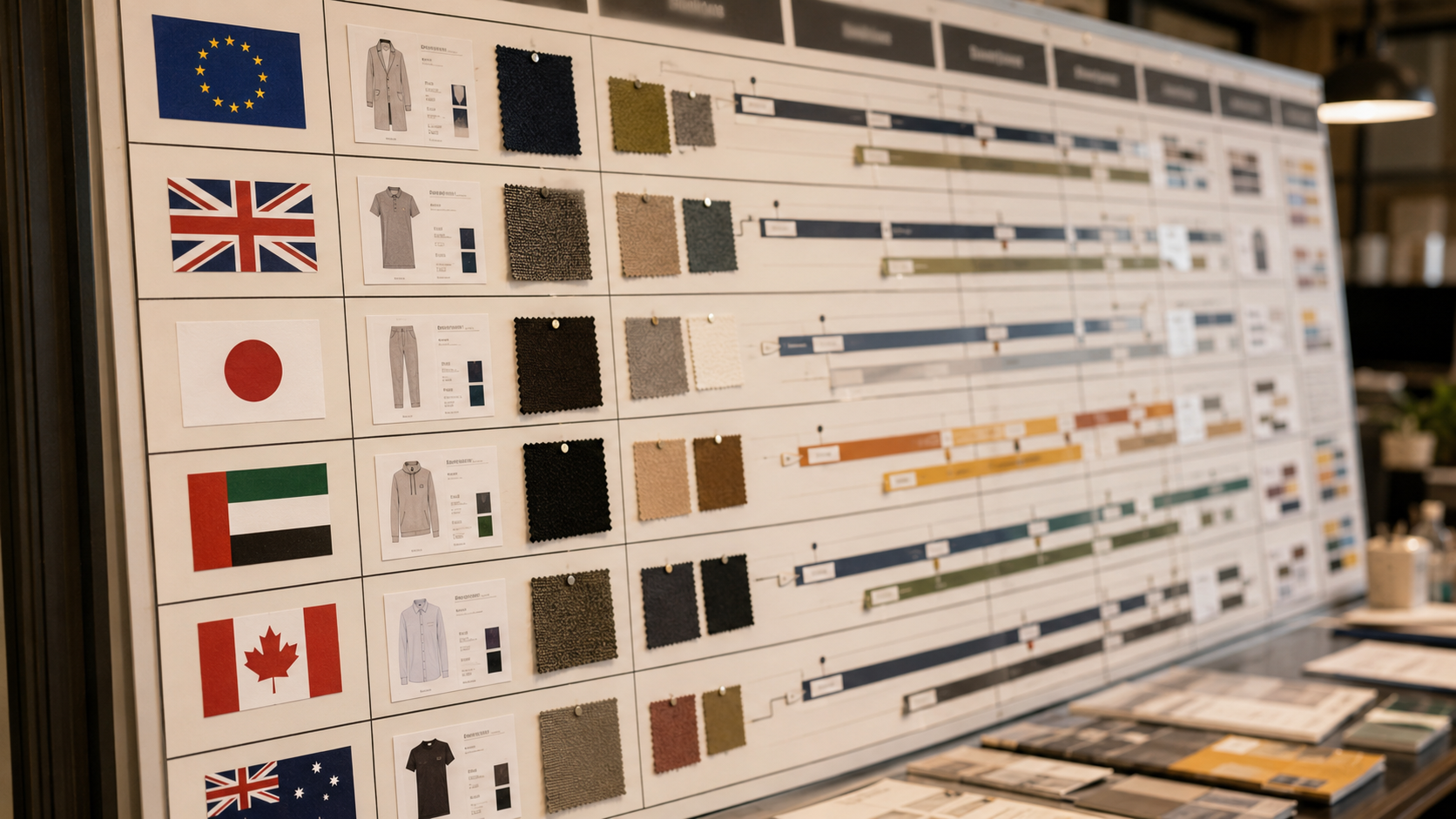
The practical consequence of Vietnam's FTA network is that a single production program in Vietnam can serve the EU, the UK, Japan, South Korea, the UAE, Israel, Singapore, Canada, Australia, and Mexico at preferential rates, while the U.S.-bound portion of the same program carries a separate duty structure. For buyers distributing across multiple markets, this makes Vietnam the only sourcing origin that offers preferential access to essentially every major non-U.S. destination through ratified, operational agreements.
Planning for this requires attention to two variables beyond the factory quote. First, fabric sourcing determines which agreements a production program can qualify for. A program using Chinese fabric qualifies for RCEP but not for EVFTA or CPTPP. A program using Vietnamese-woven or Korean fabric can qualify for EVFTA. A program using CPTPP-origin yarn and fabric can qualify for CPTPP. Buyers who ship to multiple markets from the same production run may need to work with factories that can source fabric from qualifying origins for each destination.
Second, origin documentation must be correct and complete at the time of shipment. Each agreement has its own certificate of origin requirements, and customs authorities in the destination country can reject preferential claims if the documentation does not match the rules. Factories experienced in FTA compliance will have systems for tracking fabric origin, maintaining production records, and issuing the correct certificates. This is worth verifying during factory evaluation, not after the first shipment lands at customs.
For a broader view of how tariff rates and trade conditions affect sourcing decisions, our tariff guide tracks current rates by market and garment category. Our supply chain diversification guide covers how to evaluate Vietnam as part of a multi-country sourcing strategy, and our FOB costing guide explains how duty fits into the landed cost model.
A sourcing decision built on a duty rate that has moved three times in six months was never a sourcing decision. Trade agreements are the stable layer underneath.
Vietnam Apparel Production Partner
Shipping to multiple markets from Vietnam?
Pham Fashion House helps brands plan production across destination markets, matching programs to factories with the supply chain and compliance capabilities to qualify for preferential rates. We work with buyers across North America, Europe, the Middle East, and Asia Pacific, typically for programs of 3,000+ units per style.
Get a Production Assessment