Why Apparel Feels Cheaper Even When It Costs More: What It Means for Your Brand
Your customers are noticing something real. A $120 dress, a $90 hoodie, or a $200 jacket that feels strangely disposable. The price has gone up. The garment has not always followed. And when that gap becomes visible, it reflects directly on the brand, not the factory.
Across the apparel industry, brands are under pressure from rising input costs, faster trend cycles, tariff exposure, and logistics complexity. Many are making production tradeoffs that are commercially rational in the short term but quietly damaging to the customer relationship over time. The customer may not be able to articulate what changed. But they feel it.
This article is written for brand operators, product directors, and sourcing teams who are thinking seriously about the connection between production decisions and brand trust. The quality gap is not inevitable. It is a manufacturing problem, and it has manufacturing solutions.

Why Apparel Prices Are Rising But Quality Signals Are Not Keeping Up
Fashion has always been sensitive to cost pressure. Fabric, trims, freight, duties, warehousing, labor, compliance, returns, and retail margins all shape the final price a customer sees. When any of those inputs rise, brands face difficult choices.
They can raise prices. They can accept lower margins. They can simplify designs. They can reduce fabric weight. They can change suppliers. They can remove details that customers may not notice immediately, such as internal finishing, reinforcement, lining quality, or more expensive trims.
Sometimes the customer notices those changes immediately. Other times, the garment looks fine in a product photo and feels acceptable at first try-on. The difference appears later, after wear, washing, stretching, shrinking, pilling, fading, or seam stress. By then, the purchase decision is long past but the brand impression is still forming.
That is why a product can look premium in a campaign and feel ordinary in real life. A brand can invest heavily in styling, photography, packaging, influencer content, and paid media while still underinvesting in the actual garment. The customer receives both signals. Over time, the product wins.
The core tension:
Customers evaluate marketing in seconds and garments over months. A brand can win the first impression and lose the relationship through production decisions made long before the customer ever saw the product.
The Mid-Market Squeeze: When Premium Pricing Meets Fast Fashion Pressure
For years, the industry assumed a reliable correlation between price and quality. Low price meant low durability. Higher price meant better materials and better construction. That relationship is now significantly less predictable.
Many mid-market and premium brands are operating under the same pressures as lower-cost brands. They need frequent product drops, strong social media content, rapid trend response, and constant newness. They are often competing against companies that can move faster, discount more aggressively, or produce at greater scale.
In that environment, brands may still charge premium prices while making production decisions that do not fully support a premium product. The customer ends up paying for the brand world, the aesthetic, the marketing, and the convenience, but not always for better garment engineering. The brand wins the transaction and loses the trust.
That is one reason so many products across price points now feel oddly similar. Silhouettes look familiar. Fabrics feel interchangeable. Details are simplified. The product may be commercially rational, but it does not feel distinctive or durable. And customers are starting to say so.

How Speed Is Compressing Product Development Discipline
Artificial intelligence and data-driven trend forecasting are changing how brands identify opportunities, plan assortments, and move to market. Used well, these tools help brands reduce waste, respond more intelligently to demand, and make smarter sourcing decisions.
But speed has a cost that does not always show up in the development budget.
When development cycles compress, the disciplines that protect product quality tend to compress first. Fit testing gets shortened. Fabric evaluation gets cursory. Shrinkage, colorfastness, stretch recovery, seam strength, and finishing standards get treated as formalities rather than foundations. Sampling rounds get reduced. Factory capability gets assumed rather than verified.
A trend can be identified in seconds. A garment that holds up in real use still has to be built correctly, and that takes time that speed-to-market pressure increasingly treats as optional.
A trend can be spotted quickly. Quality still has to be engineered.
What Actually Makes Clothing Feel High Quality to Your Customer
Quality is not just about fabric specification. Fabric matters, but it is one part of a system of decisions that either work together or undermine each other.
A garment feels high quality when multiple decisions compound correctly: the right material, the right pattern, the right fit, the right construction method, the right stitching, the right finishing, and the right quality control process. Two garments can share similar fabric compositions and feel completely different depending on how those decisions were made.
The gap between what the customer sees at purchase and what determines whether the product earns their trust is where most production problems live.
What your customer sees at purchase
Color, silhouette, styling, photography, price, product description, and brand image. These shape the expectation.
What determines whether you meet it
Fabric weight and hand, pattern accuracy, seam construction, trim selection, shrinkage control, finishing standards, and quality inspection discipline.
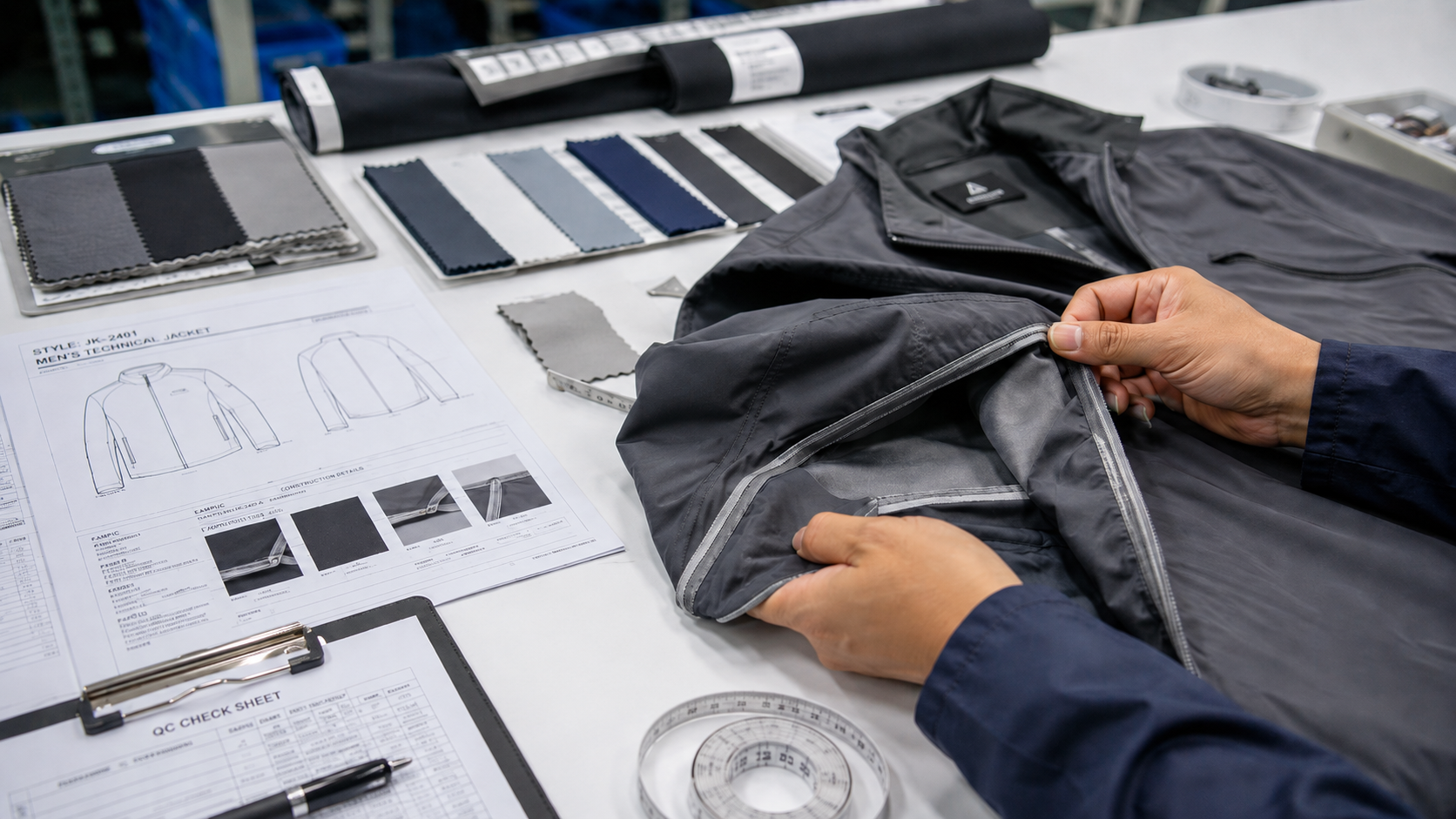
Quality cannot be added at the end of the production process. It has to be designed into the garment from the beginning, and it has to be protected throughout development, sampling, and bulk production.
The Problem With Positioning Around "Premium"
"Premium" has become one of the most overused and underdelivered words in apparel. It can mean better fabric, better fit, better construction, better design, better branding, or simply a higher price. For customers, that ambiguity creates confusion. For brands, it creates risk.
A product can be described as premium because it uses a soft fabric, without necessarily holding its shape. A garment can look elevated in campaign photography without the seams, lining, trims, or finishing having been developed to a higher standard. When the product does not deliver on the positioning, the customer's trust erodes faster than it was built.
Premium should describe how a product is made, not just how it is marketed. That means the garment has gone through a thoughtful development process. The brand understands its fabric choices. The fit has been tested. The factory is suited to the construction. The production team knows what to inspect. The final product is consistent across the size run, not just impressive in one sample.
A more useful definition:
Premium apparel should feel right when purchased, perform correctly when worn, and still feel trustworthy after repeated use. If the product only holds up to the first of those three, the positioning is costing the brand more than it is earning.
Why Manufacturing Discipline Is a Brand Asset
The brands that build lasting customer relationships are not simply the ones that move fastest to market. They are the ones that know where speed is an advantage and where discipline is non-negotiable.
A fast development cycle can help a brand stay relevant. But if the product disappoints, the customer may not return. Poor fit, inconsistent sizing, weak seams, fading fabric, and disappointing handfeel all damage trust in ways that a strong marketing campaign cannot fully repair. The customer who returns a product or leaves a negative review about quality is often reacting to a production decision made months before the garment reached them.
This is where manufacturing discipline becomes a real brand asset, not just a production detail. Strong apparel production means matching the right product to the right manufacturing partner, building complete technical specifications, sourcing materials that perform as intended, managing sampling rigorously, and inspecting bulk production against a defined and documented standard.
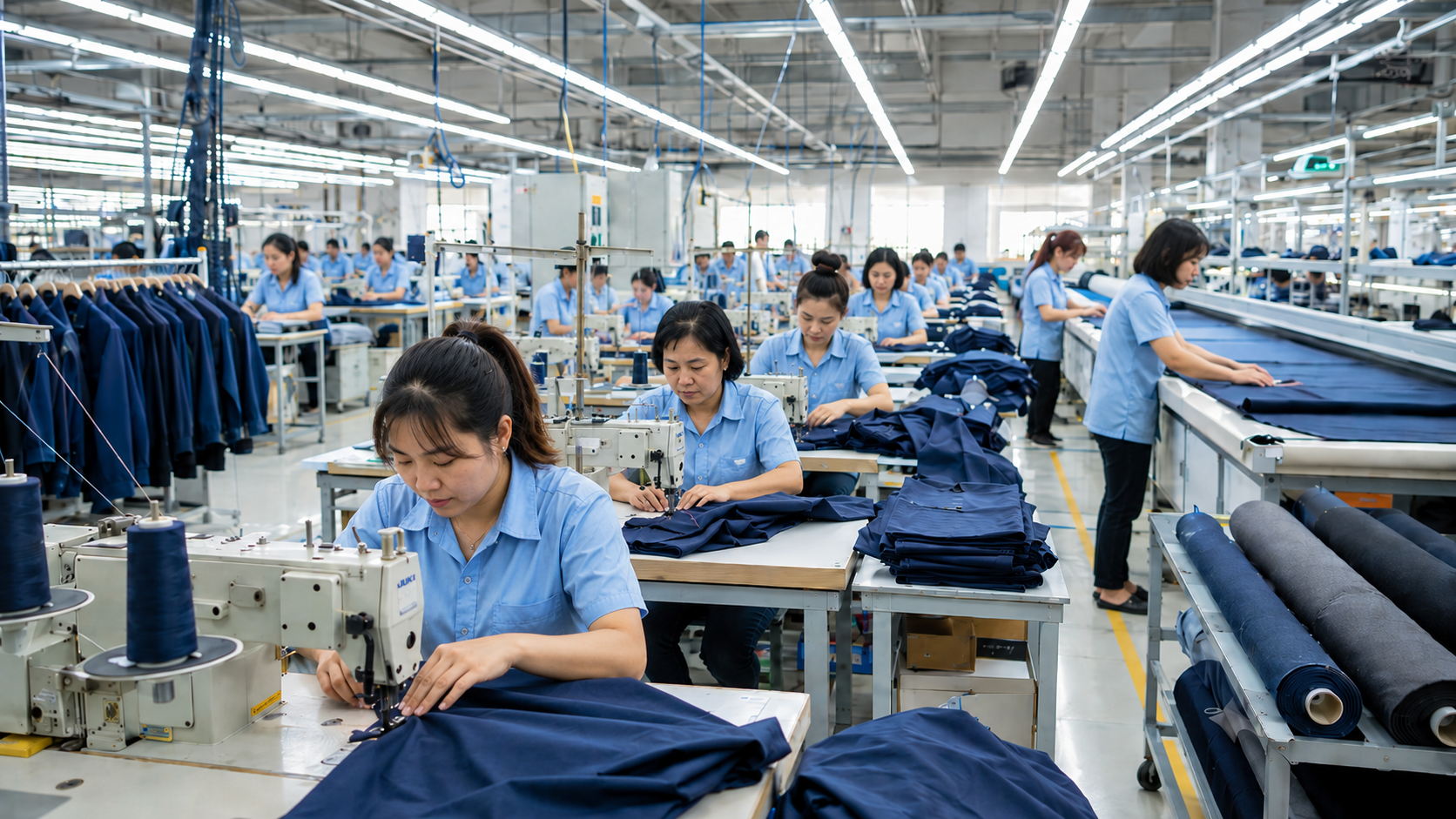
For brands sourcing production in Vietnam or evaluating new factory relationships, this is where the quality story is actually written. Not in the campaign. In the factory.
What Brand Operators Can Build Into Their Production Process
Quality at scale is not the result of finding a good factory. It is the result of building the right process around a capable factory and maintaining that process across every production run. These are the disciplines that separate brands with consistent quality from brands that get lucky on the first order and struggle on the second.
Complete tech packs before sampling
Vague specifications produce vague samples. A complete tech pack with graded measurements, fabric direction, construction notes, and trim details gives the factory what it needs to produce accurately from the first round.
Evaluate fabric performance, not just hand
How a fabric feels in a swatch tells you very little about how it performs after washing, wearing, and stretching. Colorfastness, shrinkage, pilling resistance, and seam strength all need to be evaluated before committing to bulk production.
Seal approved samples and reference them
Once a sample is approved, seal it. Every subsequent production run should be inspected against that sealed sample, not against a written description or a memory of what was approved. This is the most common quality control gap in apparel production.
Match factory capability to product complexity
A factory that produces T-shirts well is not necessarily equipped to produce a structured blazer or a technical performance garment. Factory selection should be driven by construction requirements, not just price or location.
Plan for repeat production from the first order
If a product is worth producing once, it is worth producing consistently. Establishing fabric reservations, dye lot documentation, and reorder terms before the first bulk order protects the standard on every subsequent run.
Treat quality control as a production step, not a final check
In-line inspections during production catch problems before they become bulk problems. Pre-shipment QC against a sealed approved sample is the last line of defense, not the only one. Both matter.
What This Means for Brands Evaluating Their Production Relationships
The brands that will build lasting customer trust are the ones that treat manufacturing as a core brand function rather than a cost center to be managed at arm's length. That means being intentional about factory selection, rigorous about specification, and disciplined about quality oversight across every production run.
It also means choosing production partners who understand that the garment is a brand touchpoint. A factory that produces accurately to spec, maintains consistency across a size run, and supports reorders to the same standard is not just a vendor. It is a contributor to the customer relationship.
For brands currently evaluating Vietnam as a production location, the same disciplines apply. Vietnam's export-focused factories can produce at a very high standard. The variable is not the country. It is the process the brand brings to the relationship.
Vietnam apparel production partner
Building Apparel That Earns Customer Trust at Scale
At Pham Fashion House, we help established brands and production programs connect product vision with the manufacturing discipline needed to deliver consistent quality at scale. From factory matching and sampling through production oversight and quality control, our work is focused on helping brands create apparel that performs as well as it is positioned. Programs typically start at 3,000+ units per style.
Explore Our Services